















Louvre Paris has made an amazing discovery for the art world. A 1280-dated painting that was found in the home of an older woman is now being added to their “national treasures.” The painting “Christ Mocked” was found in the home of a woman in Compiegne, France, in 2019. The painting was done by the Italian painter Cimabue.
Louvre’s New Art Addition
The French elder thought that the prized artwork was a Greek iconography. It was found when an auctioneer had been surveying the woman’s house and recommended she get the painting appraised. Cimabue is known in the art world for moving from the two-dimensional Byzantine art style and adding elements of movement into his works.
The artist, Cimabue, is said to have been taught by the art master Giotto, they even worked together. Giotto is another renowned Italian artist.
The 10 in by 8 in painting was later anonymously sold for $26 million (€24.2 million) in 2019. Furthermore, this was more than four times what the estimated sale price was. Over those four years, the painting had been analyzed by specialists at the Cabinet Turquin. In addition, Jerome Montcouquil, an employee of the Cabinet Turquin, stated the older woman had not even known where she acquired the painting.
France Purchases A Masterpiece
Although the painting was bought by an anonymous buyer, the French government blocked the export of the painting by declaring it the status of “national treasure.” This caused the painting to be stuck in France for 30 months, and in that time the French government had raised the funds to buy it.
The ministry stated that the purchase was a way for the Louvre to preserve great works. Specifically, the famous artworks that are “…coveted by the greatest museums of the world and to make them accessible to all.”
Furthermore, the ministry went on to say that this would turn the masterpiece from being seen as an icon to a painting. Finally, they stated it was a crucial decision due to there only being 15 known works by Cimabue.
Additionally, the painting “Christ Mocked” would join another work of Cimabue’s. It will hang alongside the larger painting “Maesta.” they will both be open to the public in an exhibit sometime in 2025.
Cimabue’s Early Life
The art world knows very little of the 13th-century artist, Cimabue. First, his birth name was Bencivieni di Pepo. However, Giorgio Vasari had written about some accounts of the artist’s early life. Vasari is known to be one of the first art historians. Vasari accounts of the artist’s life in his book “The Lives of the Most Excellent Painters, Sculptors and Architects” (1550).
According to the text, Cimabue was born in Florence to a noble family in the year 1240. After being sent away to a relative to learn to read and write, he then went to Santa Maria Novella convent school. At school, he learned how to sketch figures and animals in his textbooks. Followingly, Greek artists came to the church to decorate it. Cimabue parents permitted him to study the work of the Greek artists.
Early Art Works
Although Vasari is known to embellish his accounts of artists, he then says Cimabue was taught by Greek Byzantine artists. However, modern art historians believe this to be false. Moreover, Vasari said it to inflate Cimabue and show his disdain for Italian art before him.
Outside, of Vasari’s words there are no other accounts of Cimabue’s early life. Yet, his early work does seem to suggest that he was deeply influenced by the Pisan artist Giunta Pisano and Florentine painter Coppo di Marcovaldo. Through specialist analysis of style, and chronological and geographical closeness. It is also theorized that he might’ve been Marcovaldo’s apprentice.
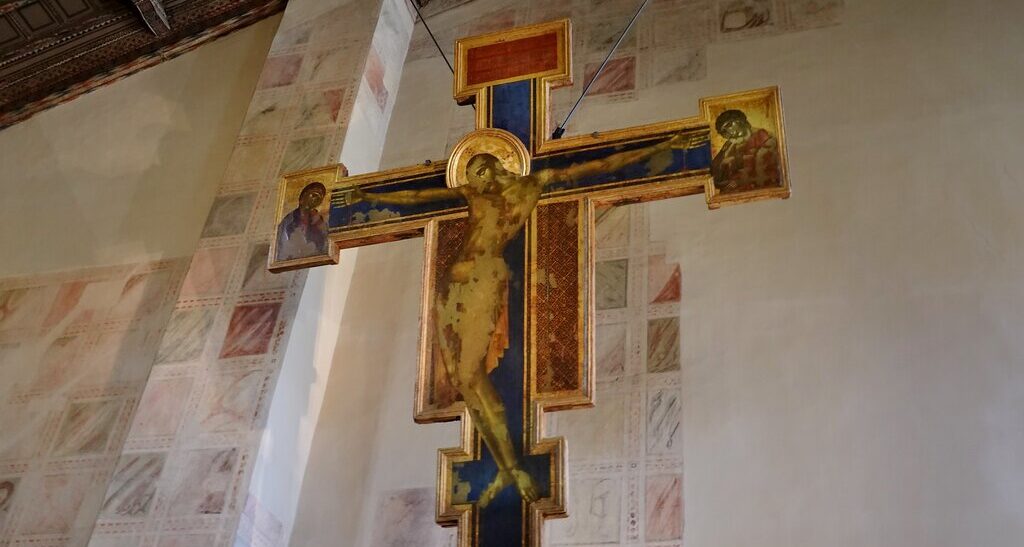
In addition, because of the lack of documentation that names Cimabue explicitly, his works can not be exactly dated and are only theorized. Yet, it is speculated one of Cimabue’s first works was a wooden cross he did for the Basilica of San Domenico in Arezzo around 1270. His cross is admired for its’ attempt to advance the Byzantine style through the humanism of religious art.
Later Art Period
Historians however can pinpoint that Cimabue was an adult and accomplished artist in the year 1272. A Roman notarial document lists “Cimabove Pictore de Florencia” as a witness. The document sheds light that Cimabue was accomplished enough to be called a ‘painter from Florence’ and that he was in his early 30s. The document also revealed his connections with powerful clergymen.
Moreover, when Cimabue came back to Florence, he created a large cross for the Basilica di Santa Croce. Sadly, it would be badly damaged in a flood in 1966. His most notable work during this time was a fresco he did for the Basilica of Saint Francesco in Assisi.
Again, historians dispute the date of the fresco. However, it’s majorly believed to have been done during the papacy of Pope Nicolas III. Meaning the fresco is dated between 1277 and 1280.
Last Years
He would later go on to create more works even earning the title “Magister Cimabue Pictor Magiestatis” (“painter/supervisor of magic status”). Sadly, not much is known of the artist’s death but a document stating his heirs had inherited his estate. Leaving historians to believe he passed in 1302. Cimabue is thought to have passed while working on two commissions. He was commissioned to paint the Pisa Cathedral and the now gone hospital Santa Chiara.
Cimabue has left behind many masterpieces that have truly left an impression on the art world. His artwork “Christ Mocked” in turn will now safely reside in the Louvre.
Written By AriAnna Rathers
Sources:
CNN– Long-lost $26 million masterpiece found in kitchen heads to the Louvre after 4-year campaign
The National News– Long-lost $26m Cimabue artwork found in kitchen added to Louvre collection
The Art Story– Cimabue
Featured Image Courtesy of Richard Mortel’s Flickr Page – Creative Commons License
First Inset Image Courtesy of Dennis Jarvis’ Flickr Page – Creative Commons License
Second Inset Image by Bobby / Shelley Courtesy of Jose and Roxanne’s Flickr Page – Creative Commons License




