














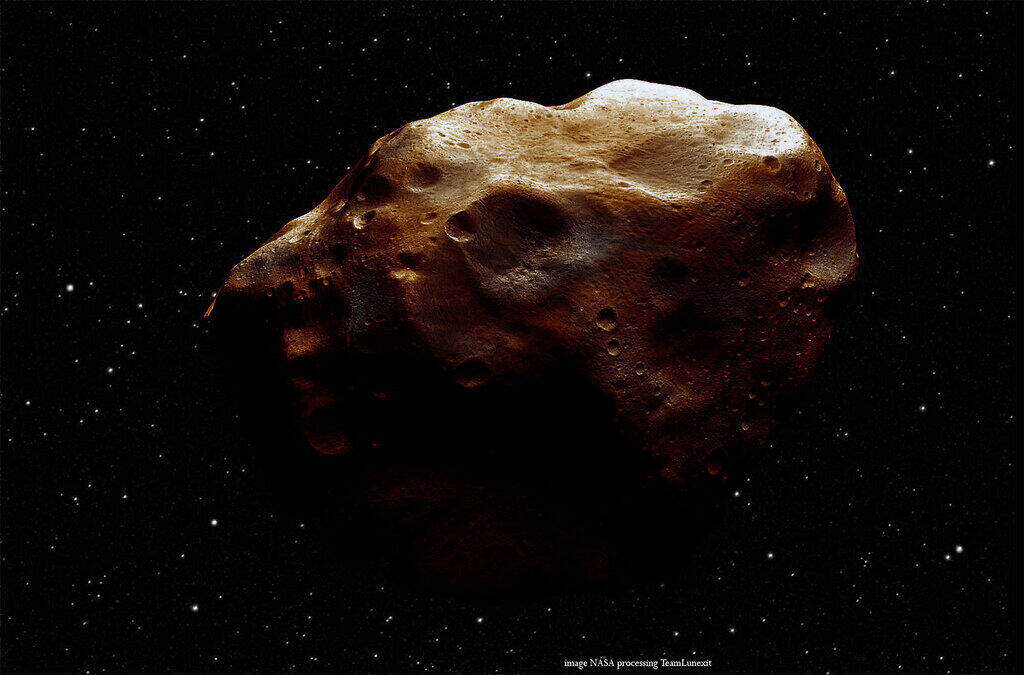
Experts have changed their previous predictions on the impact route of a massive asteroid nicknamed ‘God of Chaos’. Canadian astronomer Paul Wiegert’s latest research shows that the asteroid’s trajectory might abruptly shift. In a spectacular turn of events even if a “small object” collides with it. Now since the ‘God of Chaos’ danger has resurfaced, it is worth noting that experts earlier predicted it will come close to our planet. No closer than on the dreaded date of Friday the 13th – April 13, 2029.
The science behind the spectacle
When Apophis first came to light in 2004, reports simply placed it at level 4 according to the Torino affect danger scale. An interaction is sure likely leading to global environmental disaster that may threaten the future of civilization.
The most severe rating of every object identified since NASA started tracking potentially hazardous. NASA classifies level 4 as a close approach that merits astronomers’ attention. According to present projections, there is a one percent or greater possibility of a collision that may cause regional destruction. Most likely, new telescopic observations will result in a re-assignment to level 0. The general population and public officials should pay attention if the encounter is less than a decade away.”
Although they continue to be close experiences, additional observations ruled out a collision in 2029. However we are unable to monitor every space object; scientists frequently discover smaller objects during or just before colliding with our atmosphere.
What happens if it hits?
In the latest study, Canadian astronomer Paul Wiegert looked at the likelihood of a minor object hitting Apophis and deflecting it in Earth’s direction. A collision was practically ruled impossible in a previous analysis by Wiegert and co-author Ben Hyatt based on their examination. However, there was a remote possibility of a collision with material carrying some of the objects.
The 2029 flyby

The latest analysis examined the size of object required to turn Apophis onto an Earth-bound trajectory in 2029. These alternative trajectories could cause an Earth collision in the near future, following its close encounter in 2029. The bad news is that the meteor might be pushed through one of the 2029 “keyhole” courses around Earth by a comparatively modest impactor of about 6 meters. In 2029, Apophis would have to strike something at a height of about 3 meters (11.2 feet) in order to make an impression.
The beneficial news is that the room is abundant. It’s actually quite large. Though asteroid encounters have been witnessed and extrapolated from tracking asteroids, they are extremely uncommon. Especially considering the frequency of things above 3.4 meters that reach Earth each year. Apophis’ size (340 meters/1,100 feet), Wiegert believes the likelihood of a comet hitting is extremely low. The chances of an undetected small meteorite diverting Apophis sufficiently to steer it into an impact with Earth in 2029 would be roughly 10−8. They are considering that only 5% of these surges are in the right direction for producing an Earth impact. The total likelihood of having even a minor effect guiding Apophis into an encounter with the Earth is less than one in 2 billion.
Nevertheless, the probability of something smaller striking it and setting it up for a later collision is fewer than one in a million. These are indeed very favorable odds, but it raises the chance of impact is significantly more than initially expected.
Could the ‘god of chaos’ change its path?
Apophis, found in 2004, was formerly predicted as having a 2.7% probability of striking Earth in 2029. More findings prompted experts to rule out any possible influence in 2029 or 2036. Nonetheless, the asteroid’s changed path has sparked new questions about its future trajectory and potential threat to Earth. The ‘God of Chaos’ Apophis has gone primarily unsupervised by observatories since May 2021. It’s caused by the comparative architecture of Apophis, Earth, and the Sun, which puts the asteroid in the daytime sky for the period in question.
Regarding an initial probable 2068 impact, the 2068 impact is no longer in the category of possibility. Our calculations lack any sort of danger for more than the next 100 years.” NASA has already deployed the OSIRIS-APEX (Origin, Spectral Interpretation, Resource Identification, and Security – Apophis Explorer). A spacecraft, originally known as OSIRIS-REx, on a bonus mission to examine Apophis. As reported by the government has asked for concepts on how to prove and test capacities to fly by and identify a threatening near-Earth object.
By Desmond Jackson
iflscience : The Chance Of Asteroid Apophis Hitting Earth May Be Slightly Higher Than We Thought
Timesofindia : ‘God of Chaos’ nears Earth again?
Hindustantimes : ‘God of Chaos’ Friday 13th astronomic scare in the making: Giant asteroid could hit Earth despite previous negations
Thehill : Shelved NASA spacecraft may observe Apophis before 2029 flyby
Featured image Courtesy of 2di7 & titanio44 Flickr Page
Insert image Courtesy of Kevin Gill Flickr Page




