
















The ongoing national conversation about American policing has many facets. Racialized disproportionate violence, how they treat the homeless, and the fact that many of them tend to be white supremacists. There is a certain section of that ongoing conversation that needs some light. That being the topic of over-policing; the practice of disproportionately increasing police presence and aggression in specific neighborhoods. This practice leads to more violent encounters with the police, takes away from preventative efforts, and leads to a more antagonistic relationship with people of color especially Black people.
Over-policing is still a very significant problem in diverse areas like the city of Chicago. There have been so many examples of police brutality within the city of Chicago alone. Yet, when people discuss these tragedies there is always a discussion of what the victim could have done to avoid being murdered.
Why should the victim of a heinous act like police brutality be questioned instead of the literal authority figure? Those with great power must also bear the weight of their actions. It shouldn’t be normal to hear that children have been killed by the police. The police simply have too high a presence in Black communities.
If an officer sees an entire community as enemy combatants and can’t tell between a criminal and a Black person, then maybe they shouldn’t be on the force. There needs to be more space between the police and the Black community. For example, according to a northwestern article, ”Black and Latinx people in the United States, especially those living in low-income and segregated neighborhoods, disproportionately encounter police and experience higher levels of harassment, intimidation, and violence during those encounters. Our recent surveys find similar patterns in Chicagoland, especially among Black communities.”
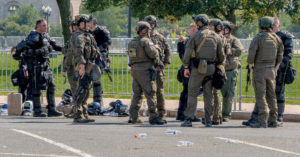
Preventative measures can do a lot for a community. Imagine for a second that instead of what is essentially a soldier who only knows how to do one thing, a mental health specialist showed up for a mental health crisis.
Wouldn’t that be nice? To have a person that isn’t carrying a gun to help with a problem that doesn’t require a gun. Someone qualified for their job instead of a person with only one thing in their tool belt. Force isn’t the only way to solve issues.
It’s time city officials understand that upping the police budget every year doesn’t solve anything. It just creates an overly armed presence around minority communities, especially the Black community. The police are agents of power, they don’t mend communities, they apply force to them. It is the only thing they know how to do. The only tool belt the police have is a hammer, and when the only thing at hand is a hammer, everything starts to look like nails.
The heightened and unnaturally large police presence in the Black community has many side effects but one of the major ones is that it makes the relationship between the police and the Black community worse. Historically speaking, the Black community and the police as an organization have been at odds. Through Jim Crow era segregation, back to the chattel slavery eras, and to the present day with public executions.
The police and Black people have had an antagonistic relationship since their first interaction. The current status quo of the standing army that patrols Black neighborhoods are just another status quo like many others before. The underlying commonality is that the police being an arm of the state to carry out the will of white supremacy and capitalism has not changed.
When the police were engaging in mass incarceration and putting Black people in prison in droves, they served their purpose. When the police’s spiritual predecessor, the slave catchers, took enslaved people back and placed them back into slavery they fulfilled their purpose. When police officers kill Black children and over-police the Black communities they serve their purpose. Everything looks like a nail to them. So maybe they shouldn’t be allowed to have hammers and shouldn’t work on any more projects.
Opinion News by Kenneth Mazerat
Edited by Sheena Robertson
Sources:
NLIHC: Housing, Neighborhood Change, & Overpolicing
Northwestern: The Racial Divide in Chicagoland’s Experiences of Policing by
Mt Innocence Project: #barriers2innocence: Over-Policing and Criminalization of BIPOC by: mtinnocenceproject
Featured and Top Image Courtesy Alper Çuğun Flickr page- Creative Commons License
Inset Image Courtesy of Victoria Pickering Flickr page- Creative Commons License




