


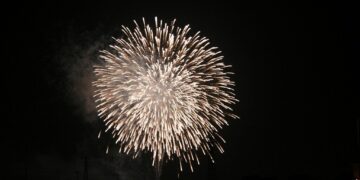








Fireworks in Motion
Many chemical reactions create bright volatile substances known as fireworks. There are a variety of different fireworks out there. Firecrackers are like a rocket, because their structure and the way they look is similar to a rocket. To ignite a firecracker, a person lights the fuse on the firecracker. The temperature goes along the fuse and stops at the bottom of the main section of the firework. This is known as the shell.
When the fuse on the firecracker ignites, it puts in motion the lift charge. They make the lift charge from black powder, also called gunpowder. It’s found at the bottom part of the shell. When it is ignited, the black powder reaction is to make hot gas and a lot of energy called unit forces. These unit forces set in motion the shell ejecting from the tube, which is recognized as mortar. This releases small pellets. The small pellets are called stars.
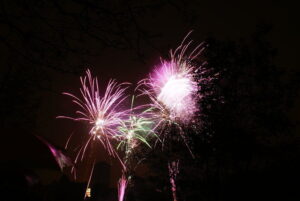
When it maintains a specific height, the time fuse sets off and starts the bust charge. Once the stars are activated in the fireworks, they explode into various colors and different sounds. The visual of it is based on what kind of star it contains, besides the size and amount of the pellets.
For instance, some stars have metal salts. They make different colors, meanwhile, different chemical mixtures result in light effects and sparkling colors. Not to mention, they made these types of salts from metal and other chemical factors.
In brief, the stars are heated and take a lot of energy. In addition, when they release heat, the particles discharge power into the shape of light.
History
The background of firecrackers is over a century long. Fireworks were created in China over 2000 years ago. Many believe they were originally developed in the second century B.C. in ancient Liuyang, China. However, some people think they originated from the Middle East or India.
One legend is that their existence was discovered by a Chinese Monk named Li Tan. After pouring a mixture of charcoal, sulfur, and saltpeter into a bamboo stick, he accidentally created the first firecracker.
It is believed that Marco Polo received gunpowder from the Chinese and he took it to Europe in the 13th century. Captain John Smith set off the first fireworks display in the American colonies in Jamestown, Virginia, in 1608, according to American folklore.
Every year on April 18, the Chinese celebrate the birth of the firecracker. They do so by paying homage to the monks.
Different Types
Today, there are many types of fireworks for people to enjoy. For example:
- Rockets: The most well known type of firework. When set in motion in the air, the Rocket can go up to an incredible height. Depending on the kind of rocket used, some can go up 30-60 meters before exploding with a loud sound.
- Sparklers: They contain a small handheld metal stick that, when ignited, performs a non-changing stream of sparks. Modern varieties are likely to be built with wood and a paper tube attached. When set off, it performs sparkles that change color by using different components.
Types of Explosions

Each type of firework has a different explosion. One type is called a barrage. They are pre-made ready “cakes” that are made of a mixture of firework varieties to make their own unique effect. It’s not a secret that these are some of the most popular fireworks products in the United Kingdom, as they let people buy a really good structure in one small package.
Cake barrages can likely have a mix of fireworks, which includes “Mines” and Roman Candles. In a nutshell, people who want to have their own show can buy multiple barrages and basically set off one at a time for pre-made fireworks.
The effect of a Mine likely will be not long, but it is for sure dramatic and spectacular. Also known as “pot á feu,” the mine is set off from a mortar shell at ground level. The explosion releases stars of color into the sky with many flashes and crashes. Mines are mainly the loudest, with levels of noise that can, on some accounts, reach as high as 120 decibels.
This is just a brief explanation of where fireworks come from and some of the various types there are.
Written by Markita Thomas
Sources:
Red Moon Fireworks: The History of Fireworks
The Science of Fireworks: Ontario science centre
Information about the different types of fireworks: Dragon fireworks
Featured and Top Image courtesy of Kelly DeLay‘s Flickr Page – Creative Commons License
First Inset Image courtesy of ahmeddin’s Flickr page – Creative Commons License
Second Inset Image courtesy of slgckgc’ Flickr page – Creative Commons License




