
















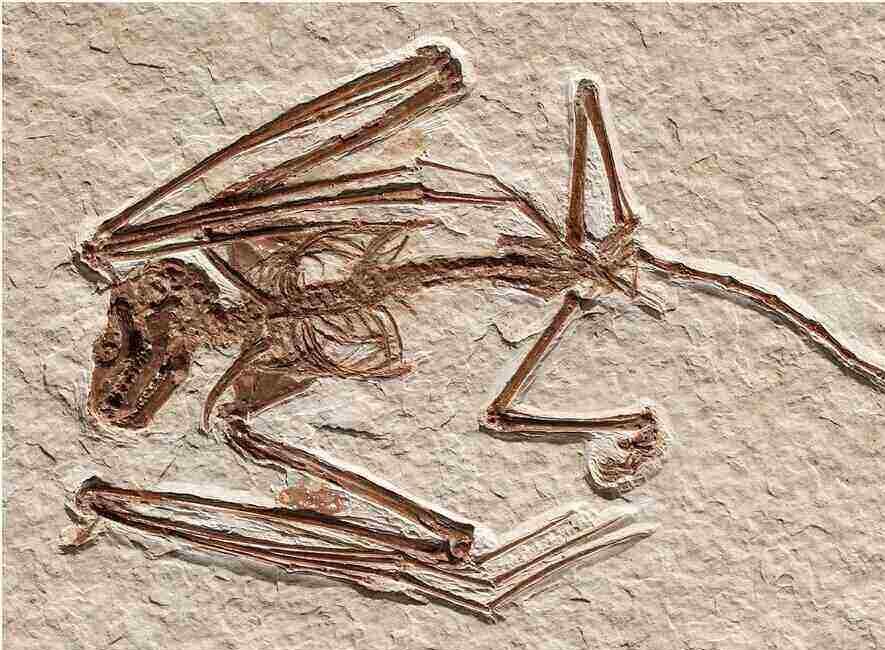
A 52 million-year-old bat skeleton has been found in Wyoming. The discovery makes this new never-before-seen species the world’s oldest bat fossil ever found. Researchers found not one but two perfectly preserved fossils in the Green River Formation located on the southwest side of the state.
New Bat Species Discovery
The newly discovered species was a tad smaller than its closest relative Icaronycteris index. When alive, and its wings folded into itself, the species would have fit in a human hand.
A bat paleontologist and collection manager at the Naturalis Biodiversity Center in Leiden, The Netherlands, and lead author, Tim Rietbergen, instantly “thought it was different” when he first saw the skeletons.
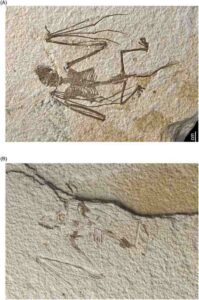 “Because they are found lower in the stratigraphy [sediment layers] compared to other fossil bats, they represent the oldest skeletons,” Rietbergen stated.
Previously, the oldest bat skeletons discovered were more than 50 million years old. That primitive species is called Onychonycteris finneyi. Like the new discovery, it was also found in Green River Formation deposits. This formation is one of the locations where researchers “find the best-preserved skeletons,” said Rietbergen.
Previously
Over the past 50 years, the Fossil Lake deposits of the Green River Formation in Wyoming have produced almost 30 bat fossils. Until the new discovery, only two species made up the fossil findings. The first species found in the Green River Formation was in 1966 — Icaronycteris index Jepsen. In 2008, the second species was discovered — Onychonycteris finneyi Simmons et al.
To measure the newly discovered species’ skeletons, researchers used CT scans. Each measurement was taken three times and they used the average total as the size of the skeletons. They used a high-resolution Phoenix v|tome|x micro-CT scanner in the Microscopy and Imaging Facility at the American Museum of Natural History.
Researchers compared the new skeletons to six Eocene bat species. They also used isolated teeth from two other extinct bats and from living species skeletons. Their comparison results led them to knowledge the new fossils belong to a never-before-seen species of Icaronycteris. They named the new species I. gunnelli after the late bat biologist Greg Gunnell.
Left with Questions
“After comparing the measurements with other bats, it clearly stood out as being a different species,” added Rietbergen. “I got super excited, and was wondering, that perhaps the bat diversity from the early Eocene was much higher than we thought.”
The new species discovery has left experts with several questions. Discovering “more well-defined and complete bat fossils” can resolve these questions, stated Emma Teeling(opens in new tab), a professor of zoology at University College Dublin in Ireland who did not participate in the research.
By Sheena Robertson
Sources:
Live Science: 52 million-year-old bat skeleton is the oldest ever found and belongs to a never-before-seen species
PLOS One: The oldest known bat skeletons and their implications for Eocene chiropteran diversification
Images Courtesy of the Researchers Who Discovered the Fossils – Creative Commons License




