















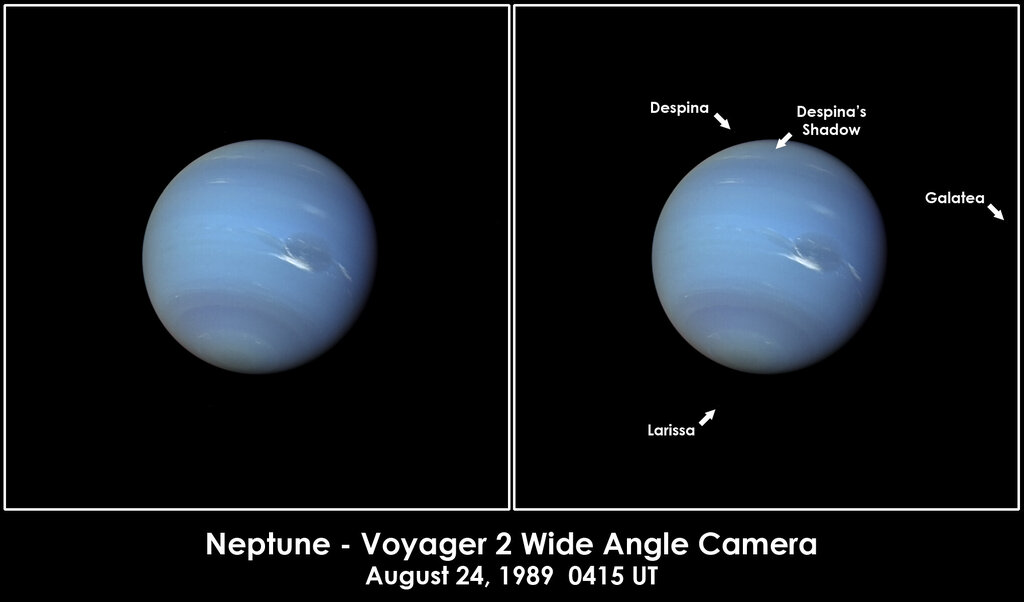
Scientists have been searching for the reasoning as to why Neptune’s clouds have disappeared. After mass amounts of research, they’ve uncovered the reason.
Mystery (Possibly) Solved
Four years ago, the 8th planet’s clouds had fully dissipated with now a sole patch on its south pole. Luckily, scientists were able to use 29 years’ worth of Neptune’s observations in order to analyze the disappearance. With further research it indicates that the amount of clouds correlates with the solar cycle.
Professor Imke de Pater theorizes that the Sun’s UV rays, when strong enough, trigger a photochemical reaction that creates the clouds. Professor Patrick Irwin goes into detail, stating that the relationship between the sun and cloud production could be a result of ionized molecules acting as cloud condensation nuclei. Therefore, initiating condensation.
Supporting Pater’s theory is not the only the observations from NASA but also the fact that Neptune is the farthest planet from the Sun. The ice giant only bathes in 0.1 percent of the intensity of sunlight that we receive on Earth. Studies also show the highest cloud activity was in 2002 and 2015. While the lowest activity was in 2007 and 2020. Solar activity is the main component in this circumstance. Solar activity can be anything from solar flares to coronal mass ejections to high-speed solar winds.
Study coauthor Carlos Alvarez finds the evolution of technology intriguing, being a major factor in the research. “Advances in technology and observations have enabled us to constrain Neptune’s atmospheric models, which are key to understanding the correlation between the ice giant’s climate and solar cycle,” said Alvarez.
Still More to Come
Although it is clear that the amount of solar activity is a possible key factor in Neptune’s production of clouds. There is more research to be done. For example, Neptune’s storms coming from the depths of the planet’s atmosphere have an impact on the planet’s cloud cover.
Even though the storms don’t have any correlation with the clouds in the upper atmosphere, it’s a variable that could interfere with the studies.
Written by: Saniya Fields
Sources:
CNN: Neptune’s Clouds Have Disappeared, and Scientists Think They Know Why by Kristen Rogers
Smithsonian Magazine: Neptune’s Clouds Have Disappeared, and the Sun Might Be Responsible by Will Sullivan
Top and Featured Image by NASA / JPL / Voyager-ISS / Justin Cowart Courtesy of Aster Cowart’s Flickr Page – Creative Commons License
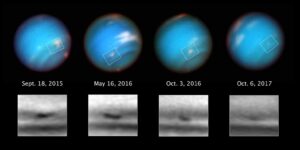
Inset Image by ESA/Hubble & NASA/D. Milisavljevic (Purdue University) Courtesy of NASA’s Marshall Space Flight Center’s Flickr Page – Creative Commons License




