
















According to the U.S. Census Bureau’s yearly data on poverty, income, and health insurance released Tuesday, the rate of poverty in the United States has massively grown. Considerably since the pandemic year benefits ran out — and the child poverty rate has more than quadrupled.
Only a year ago, child poverty had dropped to a new low of 5.2%. According to the most recent data, it is 12.4%, which is the same as the overall poverty rate. The increase happened at a time when record inflation was rising and much epidemic help was running out, but Census officials and other experts believe the youth tax credit played a contribution.
Congress quadrupled the credit amount in 2021 as part of the American Rescue Plan and expanded eligibility to encompass millions more low-income families. According to Sharon Parrott, executive director of the Center for Budget and Policy Priorities, it was a key factor in the early reduction in poverty rates.
It’s usually because the children who mostly need it get the least, while higher income children get more.”
The effort to reestablish the child tax credit
According to Parrott, when pandemic relief ceased, millions of households missed out on this credit for their children because they did not earn enough money. However, married couples must earn hundreds of thousands of dollars each year in order to receive the maximum child tax credit of $2,000 per child. While it may appear to be backward, as Parrott points out, the credit is an income-based benefit, so the more you make, the more you get.
According to polls, parents spent the majority of their additional tax credit money on necessities like rent and food.
People claim to utilize the tax credit for emergency auto repairs, to avoid late penalties on bills, and to stock up on food at a time when even food banks were experiencing recurring shortages of specific products.
Some parents used their tax credit money to pay off debt or to spend on their children. When the tax credit came to an end, studies found that parents were struggling to pay bills and satisfy basic requirements such as rent and groceries.
Angel Jackson is a single mother of an 8-year-old Child in Houston. She is a foster parent advocate and claims to be doing well. However, with inflation driving up prices, she feels worse off than she did before the epidemic’s peak.
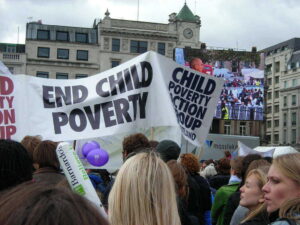
Greet (Flickr CC0)
Medium household income fell, overtaken by inflation
The huge impact on child poverty has sparked debate over restoring an enhanced child tax credit, which has been stalled in Congress.
Democrats are making an argument for it as part of bigger tax negotiations this fall. Several Republicans have presented their own solutions, which typically include lower credit and work limitations. The previous year, Florida Senator Marco Rubio suggested that, following the Supreme Court’s decision to ban abortion, Republicans needed a “pro-family” agenda that included an expanded child tax credit.
At the state level, there has been a lot of activity. Adam Ruben, of the Economic Security Project, has long advocated for governments to establish their own tax credits. Seven states had done the same thing a few years before. Ruben argues that the number has already been doubled and that only this year, 18 states have changed this or other tax programs to aid low-income parents.
Income Data
The Census Bureau also revealed updated income data last Tuesday.
Last year, the median family income decreased by 2.3% to $74,580. Lower-income employees saw the greatest salary increases, but they were overtaken by record inflation. Wages recently surpassed inflation as a result of the healthy job market. However, with the cost of rent and other necessities being so high, many Americans, like Jackson, may not be experiencing it.
Written by Angelika Cano
Sources:
NPR: Child poverty more than doubles — a year after hitting record low, Census data shows
Census Bureau: Income, Poverty, and Health Insurance Coverage in the United States
AP News: Child poverty in the US jumped and income declined in 2022 as coronavirus pandemic benefits ended
Top and Featured Image Courtesy of Pictures of Money Flickr Page – Creative Commons License
Inset Image Courtesy of Need NOT Greet Flickr Page – Creative Commons License




