















Location
The Francis Scott Key Bridge spans the Patapsco River, connecting the city of Hawkins Point with Sparrows Point and Dundalk. It is part of Interstate 695 (Baltimore Beltway) and carries a significant amount of commuter and freight traffic. Recently, tragedy struck as a cargo ship collided with it causing it to tumble to the Earth.
Design and Construction
The bridge is a through-arch bridge, which means it has a distinctive arch-shaped structure that supports the roadway above the water. It was complete in 1977 and has since become an iconic feature of Baltimore’s skyline.
Namesake
The bridge is named after Francis Scott Key, who was a prominent American lawyer, author, and poet. Key wrote the lyrics to “The Star-Spangled Banner,” which later became the national anthem of the United States. The naming of the bridge honors Key’s contributions to American history.
Importance
The Francis Scott Key Bridge plays a crucial role in the transportation network of Baltimore and the surrounding region. It facilitates the movement of vehicles, pedestrians, and cyclists between different parts of the city and serves as a key link in the Baltimore Beltway system.
Maintenance and Upgrades
Like many infrastructure projects, the Francis Scott Key Bridge requires regular maintenance and occasional upgrades to ensure its safety and efficiency. Over the years, there have been efforts to maintain and improve the bridge’s structural integrity and traffic capacity.
Planning and Construction
The idea for the Francis Scott Key Bridge dates back to the mid-20th century when Baltimore was experiencing significant growth in population and industrial activity. The need for improved transportation infrastructure led to the planning and eventual construction of the bridge.
The bridge’s design is notable for its through-arch structure, featuring a large arch that spans the Patapsco River. This design not only provides structural stability but also contributes to the bridge’s iconic appearance.
Transportation Impact
It helped ease traffic congestion and improve connectivity between different parts of the city and surrounding areas. Over the years, the Francis Scott Key Bridge has undergone various maintenance projects and upgrades to ensure its safety and functionality. These efforts include routine inspections, structural repairs, and enhancements to accommodate evolving traffic demands.
Cultural and Symbolic Significance
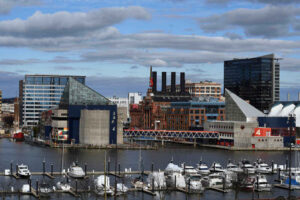
Beyond its practical transportation role, the Francis Scott Key Bridge holds cultural and symbolic significance for Baltimore residents. The Francis Scott Key Bridge has also been a focal point for community events and activities. It offers panoramic views of the Patapsco River and surrounding landscapes, attracting visitors and locals alike.
Francis Scott Key Bridge in Baltimore collapses
Wes Moore stated that workmen utilized a big crane to raise a 200-ton (180-metric ton) span of the bridge, which took ten hours. He described the item as a “relatively small lift” in the context of the vast recovery endeavor. Officials had said that the temporary channel will have a controlling depth of 11 feet (nearly 3 meters), a horizontal clearance of 264 feet (80 meters), and a vertical clearance of 96 feet (29 meters).
Meanwhile, the ship remains motionless, with all 21 crew members on board for the foreseeable future, according to authorities. According to Will Marks, the crew’s spokesperson, twenty of them are from India and one from Sri Lanka. He stated that they are now busy maintaining the ship and working with investigators from the National Transportation Safety Board and the US Coast Guard.
Lawsuit
The lawsuit seeks to limit the corporations’ liability to around $43.6 million. It believes that the vessel itself is worth up to $90 million and was carrying freight worth more than $1.1 million in revenue for the corporations. The estimate also excludes two big costs: at least $28 million in repairs and $19.5 million in salvage.
Officials are trying to figure out how to reconstruct the massive bridge, which was finished in 1977. It carried Interstate 695 across southeast Baltimore and became a symbol of the city’s working-class and marine heritage.
Other Bridge incidents
- I-35W Mississippi River Bridge (2007): One of the most well-known bridge collapses in the United States occurred on August 1, 2007, in Minneapolis, Minnesota. The I-35W Mississippi River Bridge, a steel truss arch bridge, suddenly collapsed during rush hour traffic, resulting in 13 fatalities and 145 injuries. The collapse was attributed to a design flaw involving gusset plates and inadequate inspections.
- Genoa Bridge (Morandi Bridge) (2018): The Morandi Bridge in Genoa, Italy, collapsed on August 14, 2018, killing 43 people. The bridge, which was a cable-stayed bridge, suffered from structural deterioration and lack of maintenance, leading to its catastrophic failure during a heavy rainstorm.
- Silver Bridge (1967): The Silver Bridge, a suspension bridge spanning the Ohio River between Point Pleasant, West Virginia, and Gallipolis, Ohio, collapsed on December 15, 1967. The collapse, which occurred during rush hour traffic, resulted in 46 fatalities. The cause was determined to be a fracture in a critical suspension chain link due to metal fatigue.
- Tacoma Narrows Bridge (1940): The original Tacoma Narrows Bridge in Washington state collapsed on November 7, 1940, shortly after opening to traffic. The collapse, often referred to as “Galloping Gertie,” was caused by aeroelastic flutter due to strong winds, leading to dramatic twisting and eventual failure of the bridge deck.
- Harp Bridge (2009): The Harp Bridge in Ireland collapsed on August 22, 2009, during construction. The collapse resulted in the deaths of four workers and injuries to several others. Investigations revealed design flaws and inadequate safety measures during construction.
Written by Thamara Dunlap
Sources:
AP: Baltimore Bridge
History: Bridges incidents
The Washington Post: Baltimore bridge history
Featured Image Courtesy of Stephen Rees‘s Flickr Page – Creative Commons License
Inset Image Courtesy of pontla‘s Flickr Page – Creative Commons License




