














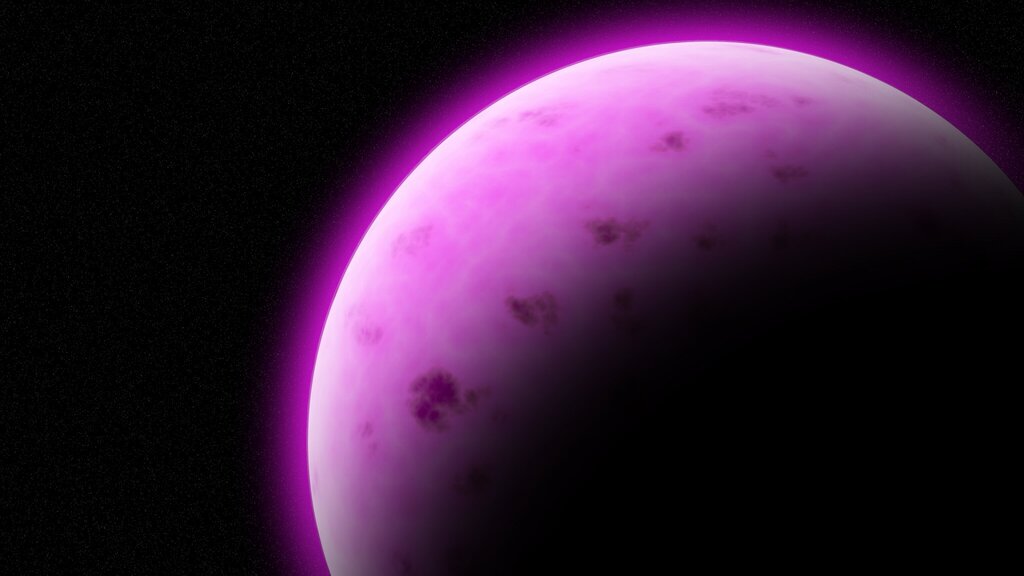
Astronomers have discovered a planet that is as fluffy and light as cotton candy floss while being significantly larger than Jupiter. Scientists classified the super fluffy planet as “WASP-193b” due to its unusually low density given its size. WASP-193b is the second least dense exoplanet found by astronomers. Its size, roughly around 50% larger than Jupiter, has left specialists perplexed.
the research of senior author Khalid Barkaoui of the Massachusetts Institute of Technology (MIT), “The planet is essentially incredibly fluffy” since it is largely composed of moving gases instead of solids. Further scientific work is going to be required until scientists can address all of the problems raised due to its fluffy nature. Researchers say WASP-193b is so light it might float on water, is perfect for researching planet creation.
The possibility of exoplanets, or those outside our solar system, was established last year. However, it took additional time and effort to figure out their consistency using terrestrial telescope measurements. The gas giant lies far from our solar system 1,200 light years apart, 5.8 trillion miles. It orbits a star comparable to the sun. It is assumed that the warmth is generated by its neighboring sunlight, which it orbits about every six days.
The development of the fluffy exoplanet occurs only days before physicists announced that our Milky Way galaxy has a “Super-Earth.” The rocky world, known as 55 Cancri e or Janssen, lies approximately 41 light years from Earth and has a radius that is roughly twice that of our globe.
Renyu Hu, of NASA’s Jet Propulsion Laboratory as well as the principal author of the research released by Nature, said “The environment is likely full of carbon dioxide or carbon monoxide, but it may also contain additional gases including as water vapour and sulfur dioxide.”
Astronomers discovered Fluffy world is an “outlier” than Jupiter by planet formation

WASP-193 b’s mass was established by measuring the gravitational tug it produces on its star as it circles. This generates the star’s speed, resulting in an alteration in the frequencies of light coming from it. Astronomers can determine the weight of the planet by measuring the extent of the distortion. In this situation, nevertheless, WASP-193 is so light that the gravitational influence on its star cannot be detected using “radial velocity.”
“We started out with extremely small amounts, which made it hard to accept in the beginning,” co-leader Francisco Pozuelos, a senior researcher at Andalucia’s Institute of Astrophysics stated. “We cannot determine how this fits into any of the current formation theories considering that it is an anomaly.” To give you an idea about how fluffy and light WASP-193 is. Earth had a mass of 5.5 grams per cubic centimeter, whereas our solar system’s gas behemoth Jupiter has a mass of about 1.3 grams per cubic centimeter. WASP-193 b possesses a mass of only 0.059 grams/cubic meter. Cotton candy is almost equivalent since its density is approximately 0.05 grams per cubic centimeter.
It’s so lightweight it’s impossible to think about a comparable, solid-state substance. It’s similar to cotton candy since they are mostly composed of light gasses instead of solids. The team believes that WASP-193 is primarily hydrogen and helium, similar to Jupiter. They believe these gasses are generating a hugely exaggerated atmosphere. While research puffed-out atmosphere is most likely caused by WASP-193 being hit by irradiation emanating from a nearby star. The research group is unsure how WASP-193 kept its super-puffy nature, given its creation theories.
Discovering the planets density than Jupiter has discovered by astronomers
To learn more about WASP-193 environment and perhaps, uncover its history. Researchers are going to employ an approach devised by de Wit. This method also employs the decreases in starlight. It traverses the front of its star to calculate atmospheric variables such as temperature, composition, and pressure at various depths.
These properties are subsequently utilized to accurately calculate it’s mass. For the time being, the research group considers WASP-193 an attractive target for further investigation. “The larger the environment, the more space light may pass through. So it’s evident that this planet represents one of the most promising candidates for studying atmospheric effects. It will be a Rosetta Stone to try to solve the mystery of puffy Jupiters,” explained de Wit.
The study received funding by consortium universities and the UK’s Science and Technology Facilities Council. The European Research Council, the Wallonia-Brussels Federation, the Heising-Simons Foundation, as well as Leslie Masson, and Peter A. Gilman, who supported this project.
By Desmond Jackson
Sources:
Space: Cotton candy exoplanet is 2nd lightest planet ever found
Sky News: WASP-193b: ‘Super fluffy’ candy floss planet bigger than Jupiter discovered by astronomers
MIT News: Astronomers spot a giant planet that is as light as cotton candy
CBS News: Researchers discover “super fluffy” planet with cotton candy-like density
Featured Image Courtesy of Viktor Basso Flickr Page – Creative Commons License
Inset Image Courtesy of Paul Stewart Flickr Page – Creative Commons License




