














Discovery
In 2021, astronomers detected the first signs of the new planet using SPECULOOS, a network of six robotic 1-meter telescopes (four in the Southern Hemisphere and two in the Northern Hemisphere). It continuously scan the sky for signs of planets orbiting ultracool dwarf stars. SPECULOOS is the parent project of the TRAPPIST (TRAnsiting Planets and PlanetesImals tiny Telescope-South) survey.
Which identified seven terrestrial planets, many of which are possibly habitable, orbiting a tiny cold star known as TRAPPIST-1. Astronomers from MIT, the University of Liège, and other institutions have discovered a new planet. It’s circling a tiny cold star just 55 light years distant. The nearest orb has Earth’s size and rocky composition, but that’s where the similarities end. Because this new universe most likely lacks an atmosphere. The team utilizing a network of telescopes as part of the SPECULOOS (Search for Planets EClipsing ULtra-cool Stars) project.
Where
The new planet circles a neighboring ultracool dwarf, a smaller and colder star than the Sun. Ultracool dwarf stars are estimate to be the most common form of star in our galaxy, but they are also the most faint, making them difficult to see in the night sky.
Because it is so near to its star, the planet receives 16 times more radiation per second than the Earth does from the sun. The team believes that such extreme and constant radiation has likely destroyed the planet’s previous atmosphere, leaving it as an airless, exposed, searing ball of rock.
The Image
The new planet’s host dwarf is around one-tenth the size of the sun and 1,000 times dimmer. The star is comparable in size to Jupiter and twice as cold as the sun. Despite this, the dwarf star emits an immense amount of energy onto the planet’s surface due to its incredibly near proximity. SPECULOOS-3b orbits its star in just 17 hours. A year on the new planet is therefore shorter than a day on Earth.
The scientists targeted the star using MIT’s Artemis telescope, the rest of the SPECULOOS network, and numerous other observatories. The multipronged studies from SPECULOOS network revealed that the star did indeed have a planet, which seemed to orbit every 17 hours. Based on the quantity of light it blocked with each passage, astronomers estimate that the planet is around the size of Earth.
Scientist thoughts
If the planet lacks an atmosphere, scientists may soon be able to determine what types of rocks are on its surface and what geological processes shaped its landscape, such as whether the planet’s crust has previously experienced magma oceans, volcanic activity, and plate tectonics.
“SPECULOOS-3b is the first planet for which we can consider moving toward constraining surface properties of planets beyond the solar system,” says research co-author Julien de Wit, an MIT associate professor of planetary sciences. “With this world, we could practically begin studying exoplanetary geology.
HD 109833 b
Astronomers found the newest planet in 2022, designated HD 109833 b, which is a Neptune-like exoplanet orbiting a G-type star. It was discovered by using the transit method. Astronomers have discovered that two exoplanets may be mainly water.
NASA announced the discovery of a new “Super-Earth” in a nearby solar system’s habitable zone. The planet, TOI-715 b, is “about one and a half times as wide as Earth.”
It’s located in a system only 137 light-years away from Earth. In a study published in Nature Astronomy, the researchers confirm the finding of SPECULOOS-3b, an Earth-sized, probable airless planet.
Plant’s Characteristics
- Planet Radius: 0.258 x Jupiter.
- Planet Type: Neptune-like.
- Discovery Method: Transit.
- Planet Mass: 8.69 Earths.
- Discovery Date: 2022.
- Orbital Radius: Unknown.
- Orbital Period: 9.2 days.
- Eccentricity: 0.18.
Anglo-Australian
The Anglo-Australian Planet Search (AAPS) is a collaboration involving astronomers in the United Kingdom and Australia. It’s a long-term initiative to identify and characterize exoplanets using the radial velocity approach.
This approach includes detecting the tiny wobble caused by the gravitational attraction of a star’s orbiting planets, which allows astronomers to deduce the planets’ presence and estimate their attributes such as mass, orbit, and, in certain cases, composition.
Since its founding, the AAPS has played an important role in the identification of several exoplanets, greatly adding to our understanding of planetary systems other than Earth.
Who really discovered HD 109833 b
HD 109833 b was found by Wood et al. in 2022. The finding was discovered using a space-based telescope (the 0.1 m TESS telescope). The parameters given below were loaded into the Open Exoplanet Catalogue from the NASA Exoplanet Archive.
HD 189733 b is an exoplanet located in the Vulpecula constellation, approximately 64.5 light-years (19.8 parsecs) from the Solar System. On Oct. 5, 2005, French astronomers found the planet circling HD 189733 by analyzing its transit across the star’s face. This discovery is another step for people and furthers the exploration of the universe.
By Thamara Dunlap
Sources:
NASA Science– HD 109833 b
Anglo-Australian telescope – Anglo-Australian
Stellar Catalog – How does HD 109833 b look
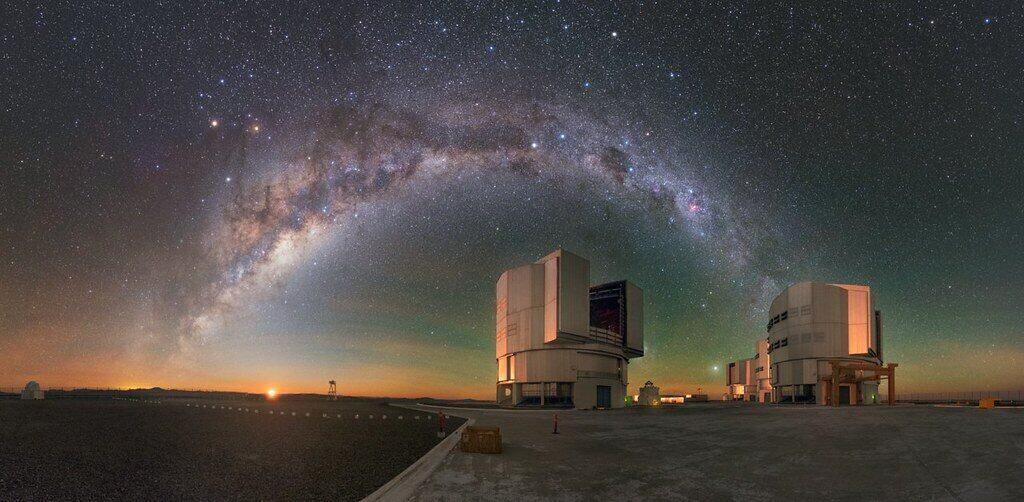
Featured Image by ESO/Y. Beletsky Courtesy of Hopeful in NJ‘s Flickr Page – Creative Commons License
Inset Image Courtesy of Chad Davis‘s Flickr Page – Creative Commons License




