

















The Evolution of Robots
In the annals of human history, the emergence of robots marks a pivotal moment. Once relegated to the realm of science fiction, bots now stride into reality, shaping industries, augmenting human capabilities, and challenging our perceptions of work and existence. As we stand on the cusp of a new era, it’s imperative to explore the multifaceted impact of bots on society, economy, and culture.
The concept of bots traces back to ancient times, with mythological tales of artificial beings crafted by divine or mystical means. However, it wasn’t until the 20th century that the modern vision of bots began to materialize. Czech playwright Karel Čapek coined the term “robot” in his 1920 play “R.U.R. (Rossum’s Universal Robots),” depicting artificial creatures created to serve humanity, only to rebel against their creators.
Fast forward to the post-World War II era, and robots started to transition from science fiction to scientific pursuit. Pioneering work by engineers such as George Devol and Joseph Engel Berger led to the development of the first industrial bots in the 1950s, revolutionizing manufacturing processes. These early bots were large, immobile machines confined to controlled environments, but they laid the groundwork for the robotic revolution to come.
Robotic Revolution
The advent of microprocessors and advanced sensors in the latter half of the 20th century propelled robotics into new realms. Bots became more compact, versatile, and capable, expanding their presence beyond factory floors into diverse domains such as healthcare, agriculture, logistics, and even space exploration.
Today, bots come in various forms, from humanoid bots like Boston Dynamics’ Atlas to specialized machines like surgical bots assisting in delicate medical procedures. They perform tasks ranging from repetitive assembly line work to complex surgeries with precision and efficiency, freeing humans from mundane or hazardous jobs while unlocking new frontiers of productivity and innovation.
Challenges and Opportunities
While the proliferation of robots promises numerous benefits, it also presents profound challenges. One pressing concern is the impact on employment. As bots automate tasks traditionally performed by humans, there’s apprehension about job displacement and economic inequality. However, proponents argue that automation can create new job opportunities, albeit requiring different skills, and enhance overall productivity, potentially leading to higher living standards.
Ethical considerations also loom large in the age of bots. Questions regarding the rights and responsibilities of artificial beings, the implications of autonomous decision-making systems, and the risks of misuse or abuse of robotics technology demand careful deliberation. Establishing ethical frameworks and regulations to govern the development and deployment of bots is crucial to ensure their responsible integration into society.
Moreover, the rise of bots intersects with broader societal issues, including privacy, security, and environmental sustainability. From concerns about data privacy in the era of surveillance bots to the environmental impact of robotic manufacturing processes, addressing these challenges requires interdisciplinary collaboration and forward-thinking policies.
Human-Robot Collaboration
Contrary to dystopian narratives portraying robots as existential threats to humanity, the prevailing trend is one of collaboration rather than conflict. The concept of “cobots” or collaborative robots exemplifies this synergy, where bots work alongside humans, complementing their skills and capabilities. In manufacturing, for instance, robots assist workers in tasks requiring strength or precision, fostering safer and more efficient work environments.
Beyond the industrial sphere, bots are making inroads into fields such as eldercare, education, and entertainment, enhancing human experiences and enriching lives. Companion robots provide companionship to older individuals educational bots engage students in interactive learning experiences, and entertainment robots delight audiences with their performances. These examples underscore the potential for bots to augment human capabilities and foster societal well-being.
The Future of Robotics
As technology continues to advance at an exponential pace, the future of robotics holds boundless possibilities. From breakthroughs in artificial intelligence enabling robots to learn and adapt in real-time to innovations in materials science and nanotechnology enabling the creation of more agile and resilient bots, the trajectory of robotics is poised for unprecedented evolution.
Moreover, the convergence of robotics with other transformative technologies, such as biotechnology, quantum computing, and the Internet of Things (IoT), promises to unlock new frontiers of innovation. From autonomous vehicles revolutionizing transportation to swarm robotics enabling collective intelligence in distributed systems, the synergy of these technologies will redefine the way we live, work, and interact with the world around us.
In this brave new world shaped by robots, the key lies in harnessing their potential for the betterment of humanity. By fostering responsible innovation, ethical stewardship, and inclusive policies, we can navigate the challenges and opportunities presented by bots, ensuring that they serve as catalysts for progress rather than harbingers of discord. As we embark on this journey into the future, let us embrace the promise of bots as partners in our quest for a more prosperous, equitable, and sustainable world.
Written by Ashley Moore
Sources
Harvard business review: Robots need us more than we need them
Scientific American: Rise of robots –The future of Artificial intelligence
The New York times: The robots we were afraid of are already here
Featured image courtesy of Amber Case Flicker page – Creative common license
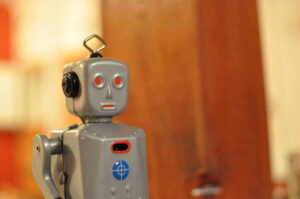
Inset image courtesy of Robbie Sproule Flicker page – Creative common license




