














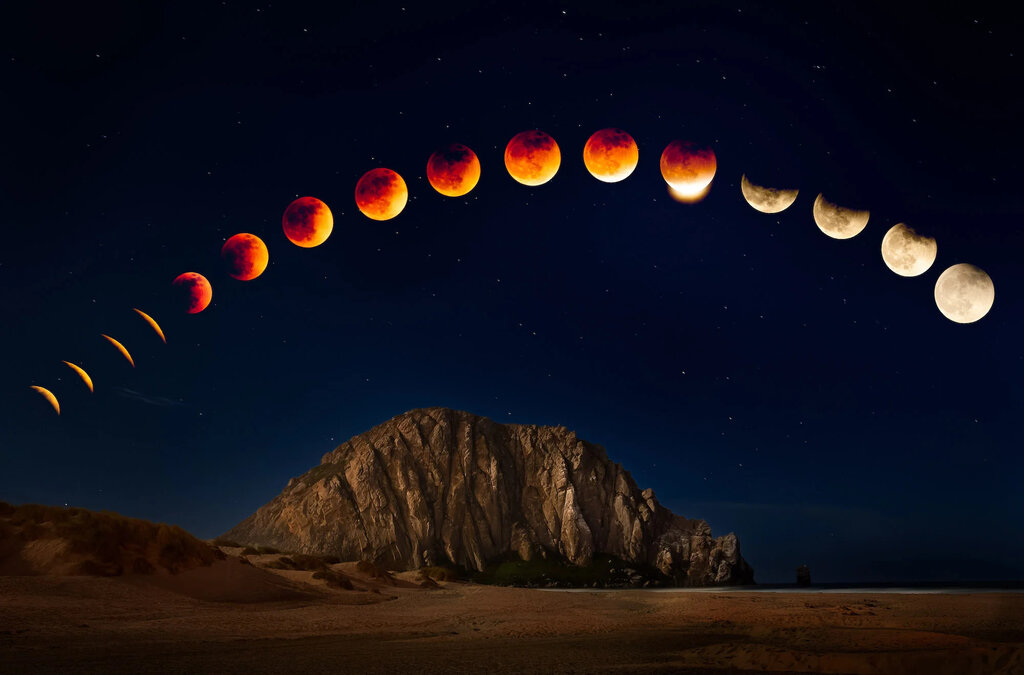
On Tuesday September 17th evening, we’ll see a partial lunar eclipse beneath a supermoon. It’s an astronomical beauty that practically everybody in the Western Hemisphere. And we can see through the clear skies. It’s an exciting lesson that our planet is part of an planetary system. This Lunar Eclipse ‘The Harvest Moon’, which has led to a slew of societal touchstones ranging from a Nintendo game. Once a year at the beginning of fall the Harvest Moon emerges near dusk and achieves peak fullness. Not only gives producers more time to work, yet it may also be a spectacular sight for skygazers across the hemisphere What is a Harvest Moon?
The Harvest Moon, despite other moonlight names is not tied to a single month instead comes annually. This implies that the Harvest Moon might be in September or October. Depending on how the lunar cycle aligns with the Gregorian calendar.
When is the eclipse, and where can I see it?
This lunar eclipse is scheduled from 8:41 pm Eastern time on Tuesday September 17th and 12:44 pm on Wednesday. The greatest annular stage is taking place at 10:44 pm and It is going to be viewable throughout the majority of the United States. Bruce Betts, the Astronomical societal head researchers, will be viewing the display from the front porch in Pasadena, California.
What does a Harvest Moon look like up the Tuesdays Night Sky?
Many skygazers believe that the month of harvest is larger, more vibrant, and more orange than the average moon. However, ‘EarthSky’ an online platform dedicated to astronomy and Earth sciences, suggests that this might be due in part to an illusion. According to NASA, the way our brains interpret the vision causes the moon to look bigger.
Since many individuals stare at the full Harvest Moon around sunset, it seems as large as any full moon. Its closeness to the perspective, at least from a skygazer’s perspective, is additionally what gives the moon its orange-ish tint. Since observers must see past a thicker fraction of Earth’s atmosphere then when looking above. The moon’s orbit across Earth is not a complete circle. Consequently, the full Harvest Moon’s separation from Earth in any given year might influence how large it looks in our skies.
Since many individuals stare at the full Harvest Moon around sunset, it seems as large as any full moon, according to EarthSky. Its closeness to the perspective, at least from a skygazer’s perspective, is additionally what gives the moon its orange-ish tint. Since observers must see past a thicker fraction of Earth’s atmosphere then when looking above. The moon’s orbit across Earth is not a complete circle. consequently, the full Harvest Moon’s separation from Earth in any given year might influence how large it looks in our skies.
Will the Harvest Moon coincide with the lunar eclipse night Sky
This year’s Harvest Moon is both a full supermoon and an annular lunar eclipse. A supermoon happens when a full moon aligns to the satellite’s nearest proximity to Earth during its elliptical path. A lunar eclipse occurs when the Earth passes across the sun and the moon. This week, the three stars crossed the line incorrectly, resulting in an incomplete lunar eclipse as Earth’s shadow falls on. The upcoming complete lunar eclipse will be visible on Tuesday September 17th night throughout the northern hemisphere. For people in the United States, it implies that all bottom 48 states ought to have an opinion. As stated by NASA, the celestial body will come under Earth’s partial shadow around 8:41 PM EDT. The peak phase of the eclipse is what watchers will desire to see. The moon will decrease somewhat about 10:13 pm, but it will reach its highest around 10:44 pm.
Are there more astronomical events coming up?
Lunar eclipses typically happen before solar eclipses, that happens whenever the moon circles the Earth’s opposite side. And passes directly across our solar system and the suns upcoming solar eclipse. October 2, a circular eclipse of the sun will be viewable just across the Pacific Ocean to the tip of South America. A full moon eclipse will be seen in Western Europe, Western Africa, and the Americas in March of next year. September’s full moon is a Supermoon. These are among the largest and clearest full moons, occurring during the elliptical orbit’s nearest proximity to Earth. And this month marks the second out of four straight supermoons this year. The most current supermoon, often known as a blue moon, arrived on August 19. The two following supermoons will occur on the days of October 17 and November 15.
By :Desmond Jackson
NYtimes: A Supermoon and Lunar Eclipse Will Light Up and Darken Tuesday’s Night Sky
USAtoday: A Harvest Moon reaches peak illumination tonight: When to look up
Space: Don’t miss the Harvest Moon Supermoon lunar eclipse tonight! Here’s what to expect
Featured Image Courtesy of Don Smith Flickr page – Creative commons
Insert Image Courtesy of TGN1 flickr Page – Creative commons




