











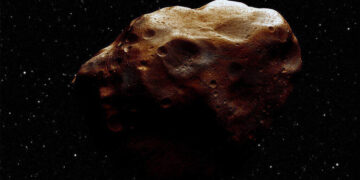




This week, two airplane-sized meteorites will fly near but securely near Earth. Beginning with a space rock 2024 JF, which is due to fly by on the evening of Monday April 6. Astronomers predict 2024 JF will reach the nearest approach tonight at 8:04 pm ET. It is going to be accompanied by 2024 JR1, an asteroid that is projected to arrive at its nearest approach on Tuesday, May 7.
The Digital Telescope Project will stream both sightings live beginning Monday at 3:30 pm ET.
Based on projections by Asteroid Watch, NASA’s Jet Research Laboratory’s monitor’s near Earth comets and asteroids. The initial object from space is expected to reach Earth’s surface at a distance of around 295,000 miles. NASA studies objects that orbits beyond 4.6 million miles of the planet, which is twenty times the distance to the moon.
Furthermore, only three days after its discovery, 2024 JR1 will be approaching Earth at a distance of 184,000 miles. The space rock is expected to be much closer to Earth compared to the moon. Around 230,000 miles away in accordance to with the Sky Live. The asteroid arrives nearest to Earth within the direction Ursa Major.
following both of the space rocks mentioned to fly past Earth, a third space rock, 2024 JD, will come close to our planet from approximately 172,741 miles away.
How does NASA track Asteroids
NASA says there’s no need to worry about a large asteroid approaching Earth, despite media reports. NASA has confirmed that a newly discovered asteroid, 2024 JE, will fly by our planet safely. Asteroid 2024 JE is predicted to be approximately 160 feet in diameter, roughly the size of a big commercial jet.
This may appear intimidating, but keep in mind that space is extremely large. Asteroids and comets continually fly about our solar system, and close encounters involving Earth occur more frequently than you might expect.
Keeping watch: Near-Earth asteroid size airplane objects that are moving towards Earth
Astronomers refer to such cosmic visitors as Near Earth Objects. Any asteroid or comet that’s trajectory gets it inside approximately 30 million miles of Earth’s path is classified as a NEO. Fortunately, a great deal of NEOs present no threat. They’re frequently considerably smaller than 2024 JE, although the larger ones normally miss us by a significant margin.
NASA’ s planetary defense network for the asteroids moving towards Earth
NASA’s uses an international network of observatories built specifically for detecting and tracking NEOs. They can precisely determine an asteroid’s status, size, and, most crucially, orbital route. By properly measuring these elements, researchers can reliably estimate the asteroid’s future.
Protecting our planet from asteroid size airplanes that are moving towards Earth
NASA’s NEO tracking and identification program is continuously on alert, scanning the skies for hazards. This proactive approach gives scientists plenty of time to design deflective measures in the improbable event that asteroids collides with Earth. Although the possibility of a massive space asteroid colliding with the Earth may sound like anything out of a science fiction film. NASA’s diligent monitoring and potential deflection operations ensure that our cosmic neighborhood stays safe.
Asteroids remain a source of concern for humanity. The previous speculations about the enormous asteroid attack that exterminated the dinosaurs on Earth are a big issue. However, this was an unusual case in history. Asteroids have always made heavenly visits to Earth. In January 2024, a small asteroid broken up above Germany, inflicting minimal damage. NASA claimed that the blast produced a spectacular flare seen from the Czech Republic. A big asteroid is now on track to pass close to Earth today. NASA identifies this space rock as Asteroid 2024 FR5.
Asteroid 2024 FR5
Asteroid 2024 FR5 is considerably larger than many of its cosmic brethren, reaching up to 150 feet wide. To put it into perspective, it’s about the size of a commercial airplane. Its rapid journey throughout space is also important, with it rushing towards Earth at an incredible speed of 18,683 km/h, according to NASA’s data.
The asteroids upcoming close encounter has received a lot of interest. On May 5th, Asteroid 2024 FR5 will make its closest approach. NASA’s JPL estimates that it will pass near a million miles of Earth. Although this distance may appear immense, the possible consequences of a change from its estimated path are significant, as even little changes could pose a hazard to Earth.
Nonetheless, there is no urgent reason to panic. NASA has closely studied the path of the asteroids and is confident that it will stay at an appropriate distance during its approach.
By Desmond Jackson
Times Now News: NASA alert 160-ft aeroplane sized asteroid moving towards earth today check distance speed time
Times Now New : NASA alert 150 foot asteroid to have close call with earth today check details
Space: Watch 2 bus-size asteroids make close flybys of Earth this week
Featured Image Courtesy of The Explorographer Flickr Page – Creative Commons License
Inset Image by ESA/D. O’Donnell Courtesy of European Space Agency Flickr Page – Creative Commons License




