
















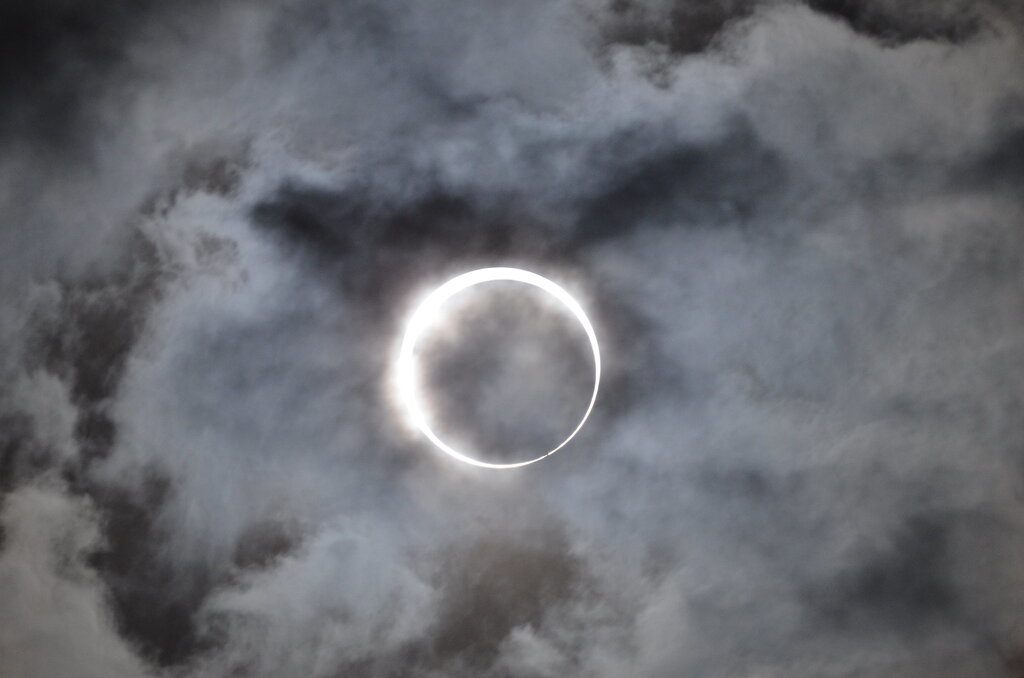
A total solar eclipse took place on Monday afternoon, providing over twelve states and countless number of towns the opportunity to experience a unique natural phenomenon that will not be visible again in the United States for another 20 years. This was the First greatest Solar Eclipse since 2017
Multiple Midwestern states, particularly Illinois, Indiana, and Ohio, experienced a full solar eclipse on Monday. In Chicago, a partial solar eclipse will occur, covering roughly 94 percent of the sun.
Total, Annular, and Partial Solar Eclipse
During a total solar eclipse, the Moon completely covers the Sun, resulting in a brief period of darkness known as totality. Total solar eclipses
are only observable from a short span on Earth’s surface known as the path of totality. Outside of this path, spectators may witness a partial eclipse.
Partial solar eclipse occurs when the Moon obscures only a portion of the Sun as seen from Earth. This occurs when the Sun, Moon, and Earth are aligned so that the Moon partially covers the Sun’s disk.
An annular solar eclipse occurs when the Moon is excessively far away from the Earth to completely illuminate the Sun’s disk, leaving a circle of sunlight referred to as the “ring of fire” surrounding the Moon. Annular eclipses occur when the Moon approaches its farthest point from Earth in its irregular cycle.
Path of Totality and Safety Precautions
When a total solar eclipse happens, the path of totality is the small strip on the Earth’s surface where the total eclipse may be seen. The extent and length of the line of totality varies based on the corresponding diameters of the Sun and Moon, as well as the gap between the Earth and the Moon. Researchers who are not in the region of totality may still see a partial eclipse.
Watching a solar eclipse necessitates extra care to shield the eyes from the Sun’s harsh brightness. Looking right at the Sun, regardless of an eclipse, can result in irreversible harm to the eyes or blindness. Solar viewing sunglasses or handheld solar viewers with certified solar filters are good options for safe viewing.
Occurrence and Frequency
Solar eclipses occur on a regular basis, although their duration and appearance are determined by a number of factors, including the Earth and Moon’s rotations. On average, there are between two and five eclipses of the sun per year, with a minimum of one full eclipse happening someplace on Earth every 18 months.
Cultural Significance
Solar eclipses have been proven culturally and symbolically significant to civilizations over time. Several ancient cultures saw eclipses as signs or supernatural happenings, frequently viewing them as warnings of imminent tragedy or interventions from God. Solar eclipses continue to inspire amazement and wonder throughout the world.
Mesoamerican Eclipses
The earliest civilizations of Mesoamerica, notably the Maya and Aztec nations, were adept astronomers who meticulously watched cosmic events. They marked solar eclipses on ancient calendars and frequently connected them with theological or legendary significance. One prominent example is the solar eclipse represented on the Aztec Sun Stone, an enormous stone monument used as a calendar and holy emblem.
Ancient Babylonian scientists were probably the first to regularly record sightings of solar eclipses. Their stone tablets, which date back to the eighth century BCE, include comprehensive accounts of eclipses and other cosmic events. These initial observations established the groundwork for subsequent study of eclipses by various cultures.
Total Eclipse of 1919,1999, and 2017
On May 29, 1919, one of modern history’s most well-known solar eclipses happened. This eclipse gave critical observational evidence that supported Albert Einstein’s proposal of universal relativity. Experts detected the noticeable curving of starlight close to the Sun’s surface throughout the eclipse. This gave factual confirmation for Einstein’s gravity theory.
This full solar eclipse was seen throughout the United States, from the West Coast to the East Coast. It was the first total solar eclipse to traverse the continental United States from east to west since 1918. Millions of people congregated across the line of completeness to observe the phenomenon, which enthralled the public and sparked great interest in astrophysics.
On August 11, 1999, a total solar eclipse was observed in regions of Europe, Asia, and Africa. It was one of the most popular lunar eclipses in history, with a lot of people visiting to see it. The eclipse path passed through multiple large towns, such as London, Paris, and Istanbul, making it available to a huge populace.
Written By Kyla Hughes
Sources:
BBC – What is a solar eclipse and when and where is the next one?




