














In the realm of astrophysics, black holes stand as enigmatic cosmic entities, shrouded in mystery and awe-inspiring in their sheer gravitational might. To probe the depths of these cosmic abysses and unravel their secrets, NASA has turned to the power of supercomputing. Recently, a groundbreaking simulation conducted by NASA supercomputer has provided a virtual journey into the heart of a black hole. Offering unprecedented insights into these gravitational behemoths.
The Enigmatic Black Hole
At the center of every black hole lies a gravitational singularity. A point of infinite density where the known laws of physics cease to apply. Surrounding this singularity is the event horizon, a boundary beyond which nothing, not even light, can escape. While black holes are invisible by nature, their presence is inferred from the effects they exert on nearby matter and light.
As NASA’s supercomputer simulations push the boundaries of what is known about black holes. They inspire future generations of scientists, engineers, and explorers to continue probing the depths of the cosmos. Just as the simulated journey into a black hole offers a virtual exploration of the unknown, it serves as a beacon of discovery. This will be guiding humanity towards new frontiers of understanding in the vast and wondrous expanse of the universe.
NASA Simulating the Unsimulatible
Simulating the intricate dynamics of a black hole presents a monumental challenge to scientists. The extreme conditions near a black hole—intense gravitational forces, relativistic effects, and warped spacetime—demand sophisticated computational techniques beyond the reach of conventional computers. Enter NASA’s supercomputer, a computational powerhouse capable of tackling the most complex astrophysical phenomena.
A Journey into the Unknown
In the simulated plunge into a black hole, researchers programmed the supercomputer to solve Einstein’s field equations of general relativity. By incorporating these equations into the simulation, scientists were able to accurately model the behavior of spacetime near the black hole’s event horizon.
As the virtual observer approaches the event horizon, they witness the phenomenon of gravitational time dilation. Meaning that the time appears to slow down, relative to an outside observer. This effect becomes more pronounced the closer one gets to the event horizon, distorting the perception of time itself.
The Gravitational Stretch
One of the most dramatic consequences of nearing a black hole is the phenomenon known as spaghettification. As an object approaches the event horizon, the gravitational forces exerted by the black hole bec
ome increasingly disparate across its length. This causes the object to be stretched into a long, thin shape. Resembling strands of spaghetti; this being a testament to the overwhelming gravitational tidal forces at play.
Insights into Black Hole
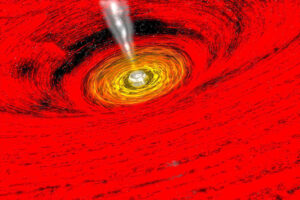
Through the simulated journey, scientists gained valuable insights into the dynamics of matter swirling around black holes, known as accretion disks. These disks consist of gas, dust, and other celestial debris. This debris spirals into the black hole under the influence of its gravitational pull. By studying the behavior of these accretion disks in the simulation, researchers can better understand the mechanisms governing the release of energy. Particularly, in the form of intense radiation, such as X-rays and gamma rays.
Unraveling Mysteries of the Cosmos
The ability to simulate the behavior of black holes with unprecedented accuracy opens new avenues for exploration in astrophysics. By refining our understanding of black hole dynamics, scientists can address fundamental questions about the nature of spacetime, the origin of cosmic phenomena, and the evolution of galaxies over cosmic timescales.
Moreover, insights gleaned from black hole simulations have practical applications beyond pure scientific curiosity. Understanding the behavior of matter under extreme gravitational conditions is crucial for various fields, including space exploration, cosmology, and theoretical physics.
Towards New Frontiers
As technology continues to advance, so too will our ability to probe the depths of the cosmos. NASA’s supercomputer simulations represent just one facet of humanity’s ongoing quest to unlock the mysteries of the universe. With each virtual journey into the unknown, we inch closer to comprehending the enigmatic nature of black holes and, by extension, the fabric of the cosmos itself.
In the ever-expanding tapestry of human knowledge, the exploration of Nasa’s black holes stands as a testament to the insatiable curiosity that drives scientific inquiry. As we continue to push the boundaries of what is known, we embark on a journey of discovery that transcends the confines of space and time, illuminating the vast and wondrous expanse of the cosmos.
The Interplay of Theory and Observation
Simulations offer a powerful tool for exploring the theoretical underpinnings of black holes. Therefore, they must ultimately be validated against observational data from telescopes and other instruments. Fortunately, advances in observational astronomy have provided astronomers with a wealth of data on black holes, from the detection of gravitational waves rippling through spacetime to the imaging of the shadow cast by the supermassive black hole at the center of the galaxy M87.
By comparing the results of simulations with observational data, scientists can refine their models and gain confidence in their ability to accurately capture the complex dynamics of black holes. This iterative process of theory and observation lies at the heart of modern astrophysics, driving our understanding of the cosmos ever forward.
Written by Adrianna Murrell
sources
space – fall into a black hole in mind bending Nasa animation
cosmos magazine – Nasa animation simulates falling into a black hole
Tech – fresh new Nasa black hole visullations
inset image – courtesy of Stuart Rankin Flickr page – creative common license
featured image – courtesy of NASA Goddard Space Flight Flickr page – creative common license




