
















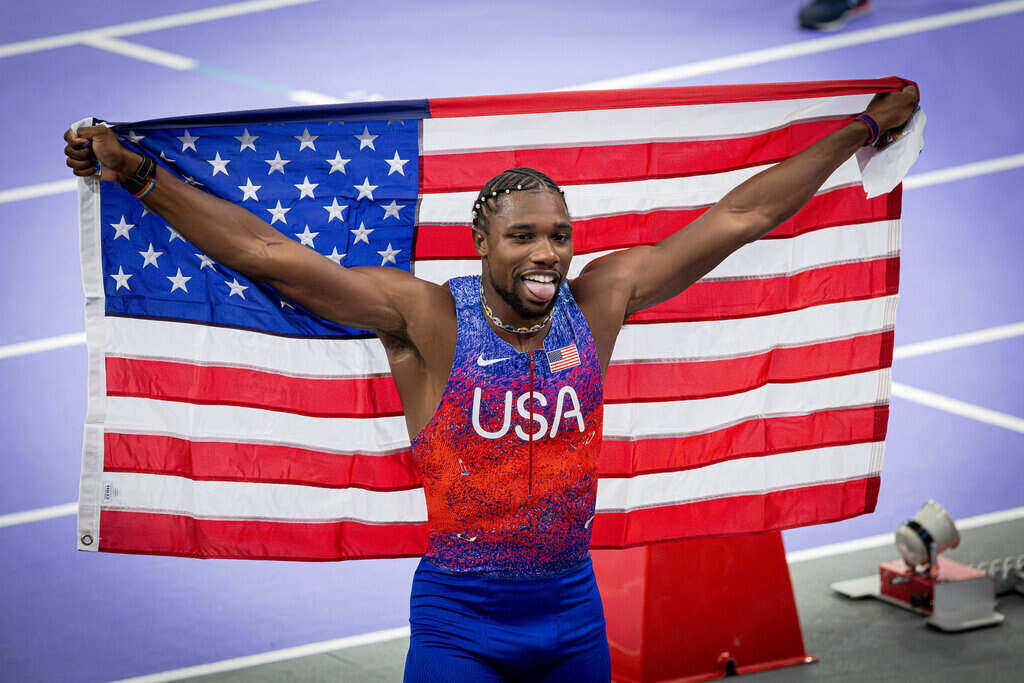
Noah Lyles stood on the far side of the track, hands crossed over the top of his head, longingly staring up at a clock. All of the effort put in since the previous Olympics, on the track, and weight room worth it? Ten seconds went by, then twenty. Then, almost 30. And then the answer appeared. Yes, Lyles was the 100-meter champion at the Paris Olympics—the world’s fastest man.
On Sunday August 4th, Noah Lyles beat out Jamaica’s Kishane Thompson by five-thousandths of a second in a race to remember. Noah Lyles stated that prior to leaving for Paris, another of his physiotherapists assured him that the race would be a squeaker. Noah Lyles said, “This is where the first and second will come to be”. Lyles claimed, pinching his thumb and forefinger together until they were nearly touching.
To put things into viewpoint, an eye blink lasts about point 1 second on average. That was 20 times longer as the difference among first and second. It was close enough that after the sprinters passed the finish line and the phrase “Photo” appeared next to the names of Lyles, Thompson.
Thompson, who ran three lanes to the far left of Lyles and having no idea where he was located on the track, was not convinced. “I was, ‘Wow, I’m still not sure, since it was that close,'” the Thompson remarked. When Lyles’ name came up first, he grabbed his name tag from the front of his jersey and raised it up to the heavens. Moments later, he exclaimed to the TV camera, “America, I told you I got this!”
Lyles Building Legacy with Each Global Gold
Noah Lyles has since established himself as Usain Bolt’s successor, blending on-track performance with his quest to become men’s athletics’ next superstar. Lyles has expressed his goal to shatter the long-standing 100m and 200m marks set by Jamaica’s Olympic champion Bolt.
Noah Lyles has also stated that he will try for four gold medals in Paris by including the men’s 4x400m relay to his plan. Having won the world 100m, 200m, and 4x100m titles in Budapest a year ago. Lyles, a three-time reigning world champion in the event, will next compete for the Olympic 200m title, having finished third in his Games debut in Tokyo three years ago. It’s been 16 years since Bolt cruised to the first of his three Olympic 100m gold medals in Beijing. Showboating as Bolt passed the finish line while posting a world record 9.69.
Lyles has yet to come close to achieving that time, racing below 9.80 for the initial time to win on Sunday night. Lyles 200m best of 19.31 falls behind Bolt’s (19.19). But, comparable to the Jamaica, Lyles competes on the sport’s biggest stages, and he proceeds to win global gold medals.
How Lyles Came from Nowhere to Win Olympic Gold
Nobody fully knew Lyles had won gold till the official findings were presented. Lyles wasn’t even in competition before the final few metres of the eye-catching purple track. Lyles tied with Letsile Tebogo for the shortest response time in the field, with a time of 0.178, significantly slower than Fred Kerley’s lightning-fast 0.108.
However, Lyles reached his peak speed of 43.6 kilometres per hour at the 60-meter mark, putting him in medal dispute. Thompson, the quickest individual in the globe this year with a personal best of 9.77, held his lead from 30 metres to 10 metres before the finish line.
The result was settled by the smallest borders, as Lyles crossed the stretch from 80 and 90 metres in 0.84 and the final 10 meters in 0.86, as opposed to 0.85 and 0.87 for Thompson.
By Desmond Jackson
BBC – How Lyles’ torso decided greatest Olympics 100m final
Nbcolympics – Noah Lyles’ 100m win puts photo finishes in focus
People – Why Noah Lyles’ 100-Meter Win Had to Be Decided with a Photo Finish
Featured Image Courtesy of Andy Miah Flickr Page – Creative Commons License
Inset Image Courtesy of Andy Miah Flickr Page – Creative Commons License




