















What They Discovered Down There?
Scientists have found a startling discovery down on the ocean floor. On the western shore of South and Central America, scientists have discovered a startling, almost alien world underneath the seafloor. There, seafloor hydrothermal vents use volcanic-powered exhaust that can reach up to 700 degrees Fahrenheit and shoot out water.
Hydrothermal vents were first discovered in 1977 in the Galapagos Islands, where researchers were surprised to find life within hostile environments. They’re made of metal sulfide deposits that create a chimney-like structure. However, researchers have never seen life forms living underneath these super vents.
Nevertheless, recent research has put to rest the previous presumptions. An expedition team led by Monika Bright, an ecologist at the University of Vienna, discovered an abundance of life living under the volcanic floor. They sailed upon “Falkor” (too), a research ship owned by Schmidt Ocean Institute. The team, representing 11 different Western institutions in July, sent down “SuBastian.”
A remotely controlled diving vehicle, fixed with different scooping, drilling, and cutting apparatuses. They mapped out about 170 square kilometers and revealed three new. They sailed from June 27 to July 29. There it lifted and dug into the floor, exposing many different forms of life, even including tubeworms, snails, and other slithering worms. An alien-looking creature that starts its life as free-moving larvae then grows to become stationary bottom feeders.
What Did They Find?
Down deep in the ocean, “SuBastian” found “hollows.” Which refers to glassy rock cavities that are filled with different structures, ranging from arches and pillars that are formed from frozen lava. Underneath the high heat of the hydrothermal vents the waters within the ‘hollows’ flow a cool 75 degrees Fahrenheit.
They found out that the organisms there rely solely on chemosynthesis. The chemical process of seawater interacting with hot magma. Researchers have also found that there are two different types of vents. They categorize them as “white smokers.” Vents that are created from barium, calcium, and silicon are white and labeled white smokers. Secondly, there are “black smokers” chimneys that are formed from iron sulfide, which subsequently is black.
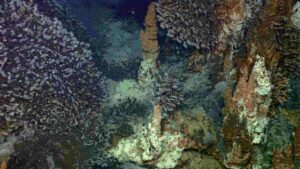
Scientists also discovered the hydrothermal vents in the ‘Lost Cities’, Puy de Folles, region were mainly black smokers. This region’s vents are powered by a process called serpentinization. A chemical process that creates heat through interaction between seawater and silicate sea mantel. The process creates energy for deep ocean life. A type of venting that is not very documented but currently being studied.
What Does It Mean
Findings like that in Puy de Folles are a curiosity to scientists. Vents like those play a critical role in the regulation of global ocean chemistry by transporting heat and chemicals from the earth’s core. These vents also house complex ecosystems for the organisms that reside there. Such as shrimp, crabs, mussels, anemones, fish and gastropods, and other types.
These hydrothermal vents are also of interest for mining their sulfide deposits for commercially valued minerals. The International Seabed Authority (ISA) has already given three exploration licenses to Russia, Poland, and France to study the mineral deposits along the Mid-Atlantic ridge.
They should approach mining within these vein regions with caution, according to some scientists. Due to the lack of understanding of these hydrothermal environments and how fragile they are. Researchers aim to learn more about these infrequent environments and if in the future they can be useful to us.
Written By AriAnna Rathers
Sources:
Yahoo News: Under a Hellish Ocean Habitat, Bizarre Animals Are Lurking
NOAA Research: Scientists discover hydrothermal vent activity along the Puy de Folles vent field
The News: Scientific expedition reveals thriving ecosystems at new hydrothermal vent fields
Monga Bay News: Seafloor life abounds around hydrothermal vents hot enough to melt lead
Phys Organization: Scientists discover three new hydrothermal vent fields on the Mid-Atlantic Ridge
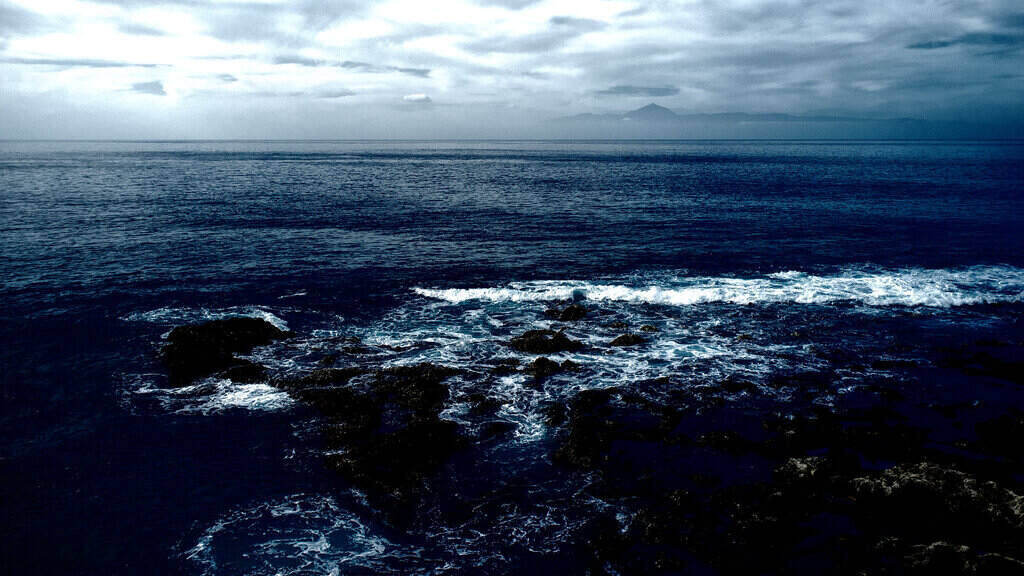
Featured Image Courtesy of Visavis..’s Flickr Page – Creative Commons License
Inset Image by NOAA Okeanos Explorer Program, INDEX-SATAL 2010 Courtesy of NOAA Photo Library’s Flickr Page – Creative Commons License




