
















Plans to “de-extinction” the dodo bird, has people thinking about similar situations seen in movies. Ones that didn’t fair so well for man-kind. US-based biotechnology and genetic engineering company Colossal Biosciences has partnered up with the Mauritian Wildlife Foundation in hopes of bringing back the extinct flightless bird.
In fact, the dodo is not the only creature the company hopes to bring back from extinction. That being said, experts believe the reintroduction of the dodo will actually be beneficial to its native lands.
Recreating Life
Colossal Bioscience is currently trying to figure out how to bring back multiple extinct species, including the woolly mammoth. Currently, the company is working with the Mauritian Wildlife Foundation in hope of locating a suitable location for the dodo birds to live once they are brought back.
Whenever companies like Colossal Biosciences makes announcements like this people become concerned about them “Playing God.” Meaning, they are trying to become creators themselves. Subsequently, people begin to think about movies like “Jurassic Park” and how mankind was affected.
Additionally, there are those who are concerned about the environmental effect this could have on the world. Sort of like introducing a new species in an area it is not from. That species then becomes invasive and causes major issues for living plant and wildlife in that area.
The Death of the Dodo
The dodo bird has been extinct since 1681. Its species died out due to a combination of predation by humans and animals introduced by humans led to its downfall.
Furthermore, this flightless bird is one of three species native to Mauritius, an island of the Indian Ocean. The other two species in the Raphidae family like the dodo were Réunion solitaire and the Rodrigues solitaire.
Around 1507, Portuguese sailors were the first to lay eyes on the dodo. Unfortunately, mankind and their introduction of other animals caused the dodo bird to become extinct by 1681. Shortly thereafter, the Réunion solitaire (1746) and the Rodrigues solitaire (1790) died out.
‘De-Extinction’
Lead paleogeneticist at Colossal, Beth Shapiro, has been able to sequence the full genome of the extinct bird. Additionally, the genetic company stated it has the sequenced genome of the Rodrigues solitaire. Furthermore, they have the genetic make up of the dodo’s closest living relative, the Nicobar pigeon.
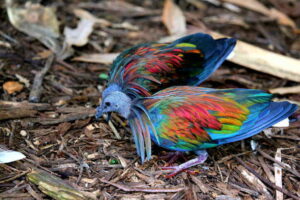 Upon further research into the living relative, scientists found cells that act as a precursor for ovaries or testes in the Nicobar pigeon can grow successfully in a chicken embryo. Now, they are studying if these cells (primordial germ cells, or PGCs) can turn into eggs and sperm.
If successful, Colossal plans to insert the edited PGCs into the embryos of sterile roosters and chickens. Thus, giving the animals the capability of reproducing. Theoretically, the once sterile birds offspring will resemble the dodo. Which would be thanks to the hybridized pigeon DNA in their reproductive systems.
Looking to the Future
A team at the Mauritian Wildlife Foundation approached Colossal earlier this year about partnering with them to help bring the dodo back from extinction. As such, they have been diligently looking for an ideal location for the birds to be seen by the public, but away from interfering factors that would lead to the dodo not surviving.
Ideally, these areas would be unpopulated with no predators, poaching, and other human interference all factors. Realistically, the “most ideal site does not exist,” stated Vikash Tatayah, director of conservation at the foundation.
As such, the foundation are looking at areas like Round Island and Île aux Aigrettes as possible sites for Colossal’s dodo to thrive.
By Sheena Robertson
Sources:
Britannica: Dodo
CNN: Not so dead as a dodo: ‘De-extinction’ plan to reintroduce bird to Mauritius
Featured Image Courtesy of Michael Coghlan‘s Flickr Page – Creative Commons License
Inset Image Courtesy of cuatrok77‘s Flickr Page – Creative Commons License




