















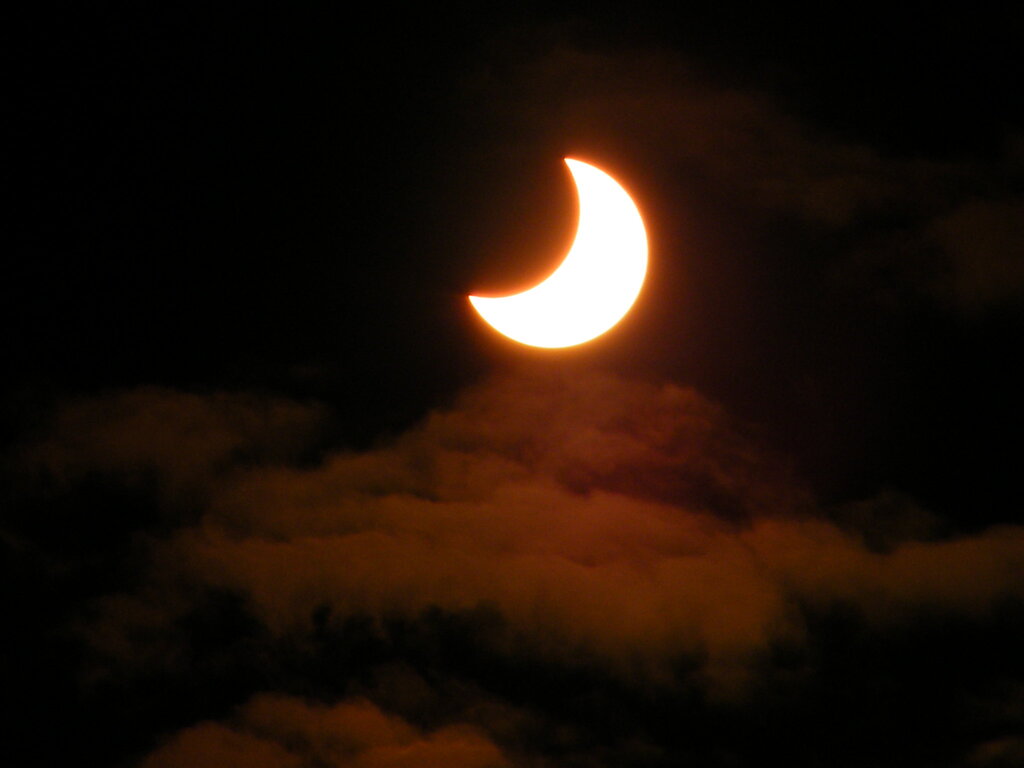
Every year, solar eclipses astonish sky watchers. All people need to do is be at the right spot at the right moment to see the darkening light. When the Sun, Moon, and Earth align, either completely or partially, a solar eclipse takes place. Eclipses provide either the Sun or the Moon a unique and interesting vista, depending on how they align.
When the moon is positioned between Earth and the sun, it casts a shadow across the planet, a solar emersion happens. According to NASA, solar eclipses only happen during a new moon phase, which happens around two times per year, when the moon lines up to obscure the sun. When viewing the phenomenon, observers should always utilize eclipse glasses or another safe means, like a pinhole projector, unless there are brief moments of totality during a total solar eclipse. This applies to seeing an annular or partial eclipse as well as before or after a complete solar eclipse reaches totality.
Classification of Solar Eclipses
- Total Solar Eclipse – occurs when the Moon moves between the Sun and Earth, totally obscuring the Sun’s face. Furthermore, it will occur for those who are in the center of the Moon’s shadow when it strikes Earth. When it happens it will get darker, almost like morning or sunset. Weather permitting, people in the path of a total solar eclipse can see the Sun’s corona. This is known as the outer atmosphere which is otherwise usually obscured by the bright face of the Sun. A total solar eclipse is the only type of solar eclipse where viewers can momentarily remove their eclipse glasses.
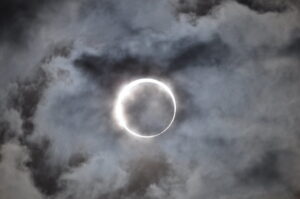
- Annual Solar Eclipse – This occurs when the Moon is at or close to its furthest point from Earth, but before it crosses the path of the Sun. Due to its greater distance from Earth, the Moon appears smaller than the Sun and covers it partially. Because of this, the crescent appears as a dark disk surrounded by a bigger, brighter disk, giving the appearance of a ring around the Moon. On April 8, 2024, the United States saw one of these.
- Lunar Eclipses – Lunar eclipses occur at the full moon phase. When Earth is positioned precisely between the Moon and Sun, Earth’s shadow falls upon the surface of the lunar. This dims it and sometimes turns the lunar surface a striking red over the course of a few hours.
- Partial Solar Eclipse – When the Moon passes partially between the Sun and the Earth, but not exactly in line, there is a partial solar eclipse. The Sun will appear to be partially veiled, forming a crescent shape. People who are not inside the region the Moon’s inner shadow covers will observe a partial solar eclipse during a total or annular solar eclipse.
What Time Is the New Moon Eclipse in Your City
When did the total solar eclipse happening in Illinois and the Chicago area last week? People’s location will determined the ideal moment to glance up (while wearing appropriate eyewear). The rare astronomical phenomenon took place across a wide swath of the United States. It marked what NBC 5 Storm Team Meteorologist Kevin Jeanes called “the greatest solar immersion across the U.S. in our lifetime.” The biggest Illinois city in the path was Carbondale. They experienced totality at around 1:59 p.m.
With the “corona” flaring around the edges of the lunar and darkening skies, stargazers will be able to view the eclipse without any assistance during this time. If you’ll be in Chicago and won’t be able to see the eclipse in totality, there’s a silver lining. The partial eclipse will be visible for a while longer.
Aurora
The fragmentary eclipse started at 12:50 p.m., reached maximum at 2:06 p.m. and ended at 3:31 p.m.
Chicago
Chicagoans viewed the fragmentary eclipse at 12:51 p.m. It reached it’s maximum at 2:07 p.m. and finished at 3:22 p.m.
DeKalb
The fragmentary eclipse started 12:50 p.m. reached maximum at 2:06 p.m. and ended at 3:20 p.m.
Evanston
The fragmentary eclipse began at 12:51 p.m. in Evanston. The maximum eclipse happened 2:07 p.m. and ended at 3:22 p.m.
Plainfield
For those watching he fragmentary eclipse in Plainfield, it started at 12:50 p.m. The maximum eclipse happened at 2:06 p.m. Lastly, it ended at 3:21 p.m.
Schaumburg
The fragmentary eclipse started at 12:51 p.m. in Schaumburg. The maximum eclipse began at 2:07 p.m. With it ending at 3:21 pm.
Wheaton
In Wheaton, the fragmentary eclipse began at 12:50 p.m. Furthermore, the maximum eclipse started at 2:07pm. Leaving it to end at 3:21 p.m.
Written by Dijana Reedfields
Sources:
NBC Chicago – What time is the solar eclipse in Chicago and Illinois? A city-by-city breakdown
NASA Science – Types of Solar Eclipses
Space.com – What is a solar eclipse?
Featured Image Courtesy of David Paleino‘s Flickr Page – Creative Commons License
Inset Image Courtesy of Takeshi Kuboki‘s Flickr Page – Creative Commons License




