
















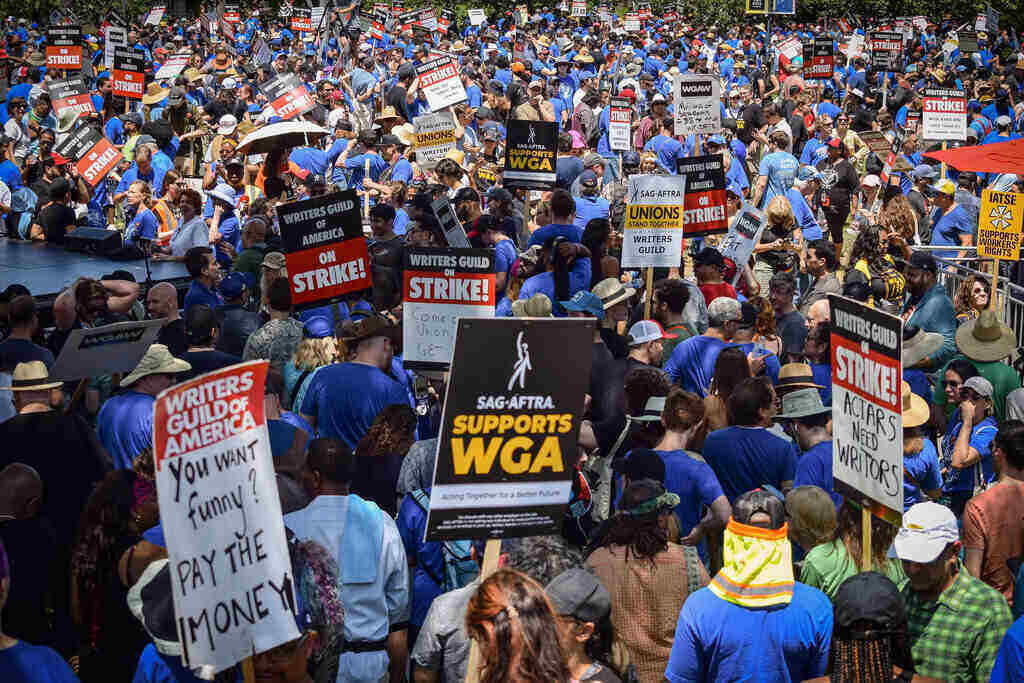
WGA and SAG-AFTRA are standing united as they battle against AI technology, trying to take away their livelihood. In May, the Writers Guild of America (WGA) went on strike over ongoing contract disputes. All they want is a fair and equitable contract. However, the Alliance of Motion Picture and Television Producers (AMPTP) and the WGA could not reason with one another, leading the writers to go on strike.
On July 13, 2023, SAG-AFTRA sent out a notice to all of its members declaring a strike on all productions done under them. The actors union also failed in their attempt to charter a new contract with AMPTP and have since stood in solidarity with the WGA and Teamsters who previously joined the protests in support.
WGA and SAG-AFTRA Stand United
SAG-AFTRA President Fran Drescher has vocalized the disappointment and frustration that both unions are feeling. She has pointed out in several interviews and amongst those picketing that the unions have tried to be reasonable. The Guild even extended negotiations with the AMPTP for 12 days after their set expiration date.
Standing outside Warner Bros. Drescher stated the Guild felt that AMPTP “just wanted to continue to squeeze us out of our livelihoods.”
We are their partners and we’re being treated disrespectfully and dishonorably.
 Disney chief, Bob Iger, went on record saying the demands of SAG-AFTRA and WGA were “not realistic.” Not long after, Drescher snapped back asking how he could call them that when he makes “$78,000 a day.”
Unrealistic Demands or Are They?
And what unrealistic demands do both unions have? They want to be paid fairly. For example, before streaming platforms were a thing, writers and actors were paid handsomely for the hard work they did. Every season had around 20 episodes. Plus, they were able to receive money when the shows aired on TV — every time.
Now, with streaming platforms:
- Each season does good to have 10 episodes.
- They get paid close to if not under half of, what they used to make.
- And they are not paid royalties.
Battle Against AI
During negotiations with both sides, APTP has tried to slip in a clause that allows them to use AI to duplicate a person’s writing style and likeness. This would take jobs away from those individuals and their financial stability.
This concern is something the SAG-AFTRA and WGA share with many other industries. As technology progresses, more companies begin looking for ways to utilize it to “Cut Labor Costs.”
In layman’s terms, use in place of humans. For example, a telephone answering service company in the Philippines recently announced they are transitioning to AI representatives.
Double Strike
When SAG-AFTRA joined the Writers Guild of America in their protest, it became the first double strike since the 1960s. Additionally, the last strike the WGA had was from the end of 2007 into 2008 and lasted 100 days. That strike cost California’s economy around $2.1 billion dollars.
On the other hand, the actors have come close to a strike or two since the 1960s. However, they were able to mediate a deal before they had to take action.
Now that both sides have rallied together halting numerous productions, people expect the economic hit to be far greater than the $2.1 billion mark. Especially, since actors, writers, and Teamsters from all across the nation are beginning to stand in solidarity. Not just for themselves, but for all of those whose jobs are being threatened in the battle against AI.
By Sheena Robertson
Sources:
The Hollywood Reporter: Fran Drescher on Bob Iger: He Says “We’re Unrealistic When He’s Making $78,000 a Day”
WGA Contract 2023: From the Studios to Santa Clarita: A Surge of Solidarity
SAG-AFTRA: Strike Notice and Order
The Hollywood Reporter: Fran Drescher Q&A On SAG-AFTRA Strike: “The Digital Age Is Cannibalizing Us”
Top and Featured Image Courtesy of ufcw770‘s Flickr Page – Creative Commons
Inset Image Courtesy of Eden, Janine and Jim‘s Flickr Page – Creative Commons License




