















Dysfunctional Environment
A world with “word pollution” is a world that contains the makings of some toxic traits and environments. Let me start with a statement about parents. Furthermore, I believe that every parent wants to do their very best in creating an environment where their children can grow and be safe, and experience love. Additionally, by being allowed to express themselves, they become responsible adults and community members.
The problem is that, because of systemic racism, growing up in dysfunctional families themselves, and not being given all of the above that they want for their children, many parents do not know what a loving, caring family, a good education, a safe and livable home “look like” or “feel like.” Oftentimes many parents in poor communities work multiple jobs, endure great stress and trauma, and this gets laid on their children, who pass it on to the next generation, continuing a cycle of intergenerational trauma that can spill out into violence and continued poverty.
Word Pollution
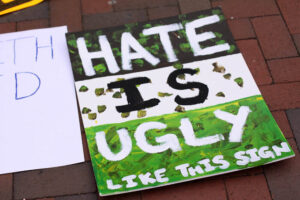
I want to address the environmental focus of this issue of the Chicago Leader on a threat to the environment, which I call “word pollution.” Words have power: to lift up or to destroy, to encourage or destroy one’s spirit. It is common knowledge that, for every negative thing said to someone, it takes 10 positive things to overcome that one negative thing. Every time I hear a parent correcting their child with a curse word or a putdown, I am saddened that this may be a daily thing that tears at the spirit of a child. Coupled with physical abuse or isolation, the trauma is magnified.
When I hear that a teacher has told their students that they “are stupid and will never amount to anything,” I weep for those children. When I hear a pastor at a funeral for a young person proclaim to the friends gathered there that the deceased youth is in hell because he was part of a gang or involved in drugs or rap music, I am horrified. This has happened at least three funerals I’ve attended in other churches. Words have power!
Research studies show that in households where there is stability and good educational opportunities, the words used are 80% positive and 20% negative. In communities beset by poverty, the reverse is true:
- 80% of the words used in homes are negative.
- And 20% are positive.
Power of Words in All Environments
Magnifying the “word pollution” in our society are politicians who bully, make up negative nicknames, and engage in a politics of “talking at” and “talking about” others rather than “talking with” others in real dialogue.
In the Catholic Christian tradition — Gospel of John — we are told that “the Word became flesh.” In this sense the Word was God.
We believe the Word spoken by the Father, birthed into the world by the Virgin Mary, was pure, all-loving, and ever-life-giving. As members of families and communities, we are called to enflesh that positive “Word” in our lives. Not just by quoting Scripture, but by doing our best. Through our words and actions, through our listening, embracing, speaking, and using all of our senses to convey to each other that we are all precious children of God.
Each of us deserving of the opportunity to pursue our unique God-given potential. Moreover, we have the right to realize our dreams and add our unique value to the world. Every negative word meant to harm can frustrate — and often does frustrate — the pursuit of those dreams.
Ways to Resolve Word Pollution
How do we eliminate word pollution? We do so by:
- By affirming each other.
- Expressing gratitude to our parents who are doing their best.
- Affirming our children.
- Challenging them.
- And helping them to develop a positive sense of self.
Furthermore by regarding them, not just as “our future,” but seeing them as a very important part of “our present,” with things to teach us, adults, as well.
We can resolve to meet negativity with positivity. Negative energy begets negative energy. To end the cycle we resolve to react only with positivity. Not easy, but essential if we are ever going to eliminate “word pollution.”
Breaking Generational Cycles of Word Pollution
So let me start. Thank you to our parents who are doing their best, seeking help in finding ways to break generational cycles of negativity. Additionally, thank you to our children and youth, who give me hope. I learn from them whenever I have the chance to have a conversation with them. Thank you to our teachers who are patient, caring, and avoid negativity. Moreover, these individuals help our youth grow into their God-given identities. Furthermore, thank you to all of our social service personnel, volunteers, and to our law enforcement, who treat youth and parents with dignity, respect, fairness, compassion, and mercy.
Written by Fr. Larry Dowling
Top and Featured Image Courtesy of Laura L‘s Flickr Page – Creative Commons License
Inset Image Courtesy of Jessica Lucia‘s Flickr Page – Creative Commons License




