
















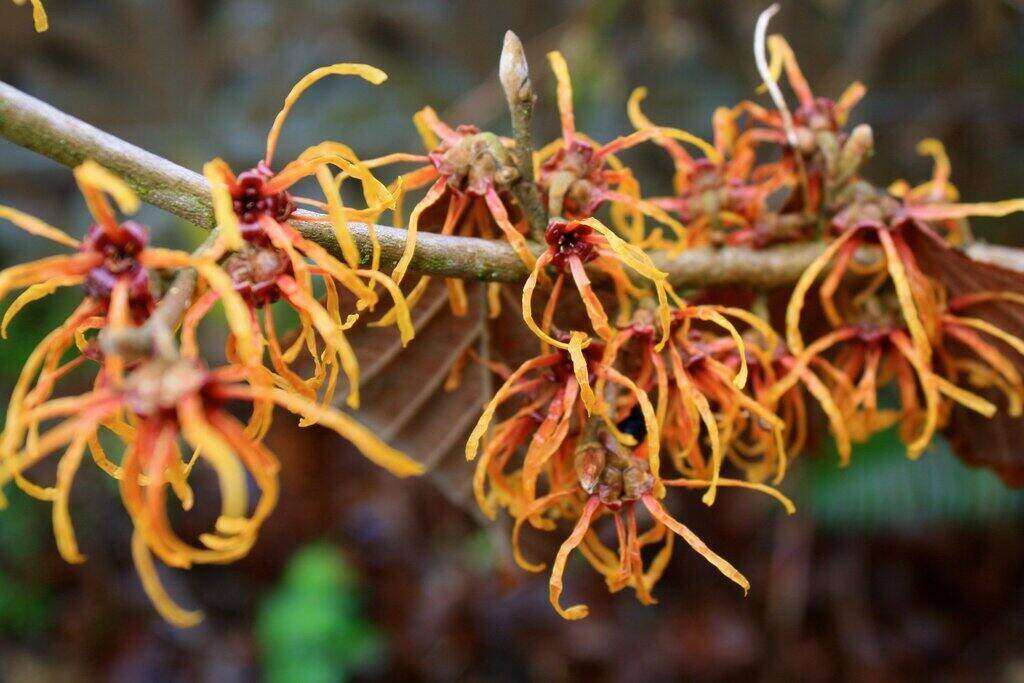
You may know witch hazel as a natural topical skin toner or be in use as a natural medicine. But did you know witch hazel could help with the evolution of robots?
Speedy Seeds
Witch hazel plants have a unique ability — they can propel their seeds approximately 30 feet per second. Close to the same speed as a bullet shot from a rifle. This particular action has caught the eyes of biophysicists and engineers seeing as that the seeds propel from a spring-like mechanism built within the plant. Scientists have also compared the function similar to squeezing a watermelon seed between your fingers.
To provide further insight, the process involves the smooth seed and the solid casing called the endocarp. When it’s time for the seed to release, the endocarp begins to dry out and warp inward. In result, the distortion applies force to the seed. However, the seed resists the force causing pressure to build up potential energy within the endocarp. Finally, once the pressure level is large enough, it overcomes the seed’s resistance, and the seed is ejected forcibly.
For many years, the Chinese witch hazel plant, native to western China, has been the main subject of many studies. However, researchers at Duke University, are studying three variations of the witch hazel species to go further in-depth in regards to the mechanics of this seed-shooting plant.
The Study
Subsequently, graduate student, Justin Jorge, and Professor Shelia Patek, hailing from Duke University, are the ones who conducted the in-depth study on this flowering shrub. “People ask me all the time, ‘Why are you looking at seed-shooting plants?'” said Jorge. And the reason? The peculiarity of the plant’s springs along with the hopes of transferring that mechanism to robots. Jorge states “Perhaps there are some benefits to these shapes that can be used to improve the design of synthetic springs, such as those used in small jumping robots…”

Furthermore, the pair began conducting their study by collecting the three variations from the Duke Gardens or Duke Forest. Collecting the plants, they set up a high-speed camera recording the trajectories at 100,000 frames per second. After the seeds launched, Jorge collected the seeds, running various tests and measuring the mass of both the seeds and endocarps to assess the ratio of these two variables.
Typically, there’s a trade-off between the projectile’s mass and its’ launch speed. For example, heavier arrows fired by a crossbow move more slowly than lighter arrows. But while analyzing the data, Jorge and Patek discover that the launch speeds of the three different witch hazel seeds were essentially the same even though they have different masses.
The two scientists even compared the seed’s adaption to the likes of a species of mantis shrimp, whom can also increase elastic potential energy storage in proportion to increases in body mass. The heavier seeds have larger endocarps that store more potential energy.
What Does This Mean For Robots/Technology?
You may be wondering what does this have to do with robots/technology? Well, with the research that has been shown in this study, it is possible that this information could help improve robotic motors and spring-operated machinery. The way that the seeds have a singular structure that operates on both motor and spring mechanics, poses as a significant advantage, according to Jorge and Patek.
A 2021 study details of a synthetic hydrogel jumper, the design influenced by plants, that jumps by spring actuation. The team concludes their research saying that results produced by the witch hazel plants provides a plethora of examples that can be useful for the construction of future motor-spring structures.
Hopefully we get to see this research be applied and created in the near future.
Written by Saniya Fields
Sources:
ARS Technica: Pew, pew, pew! These Plants Shoot Out Their Seeds Like Bullets by Jennifer Ouellette
New Atlas: Seed-shooting Plant Could Inspire Better Jumping Robots by Ben Coxworth
Earth: Witch Hazel Plants Propel Seeds at Bullet Speeds by Chrissy Sexton
Top and featured image Courtesy of Sharin’s Flickr Page – Creative Commons License
Inset image Courtesy of Akamu Adam’s Flickr Page – Creative Commons License




