









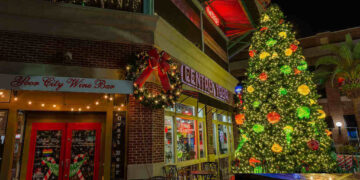







Before Little Village was brimming with Latino-American culture it saw an influx of Czech, Polish and German immigrants. After the Great Chicago Fire of 1871, the settlement of the South Lawndale community area began.
Edwin J. Decker and Alden C. Millard gave up their stationery business to build a prosperous neighborhood on the outskirts of Chicago’s predominantly Angelo-Saxon residents. The two chose this location because the land was moderately priced and the Quincy, Burlington, Chicago railroad ran through the area.
Millard was developed as the main street. It had stores, a hotel, a park, a post office, churches, and other amenities. Unfortunately, Decker and Millard’s business venture failed in May 1876. However, their work paved the pathway for the future development of Little Village.
The neighborhood around 26th Street was known as “Czech California.” Shortly after the second half of the 20th-century the Eastern European, Bohemian, and Polish residents moved west past the city limits of Berwyn and Cicero. Soon afterward the area became resettled by Latino Immigrants.
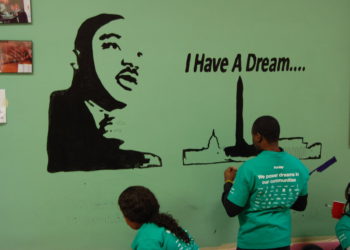
In the 1950s and 1960s, Blacks began to move into North Lawndale. During this time period, they were only allowed to purchase things in certain areas of the city. Predujicism was high during this time and the Black residents were forced to purchase homes more than their values. They had to buy these homes without the financial help of loans and subsidies that White people had access to.
Sadly, expanding Black neighborhoods suffered from a decline in industrial jobs, deteriorated housing stock, lack of city services, and overcrowded schools. In 1965, Martin Luther King, Jr. brought his campaign to Chicago. To highlight severe inequality in housing, he chose to live in North Lawndale.
Due to business and political interests in South Lawndale (Little Village) worked to keep the community “stable” and retain local business. They renamed South Lawndale to Little Village in order to separate the community’s image from North Lawndale as it became a predominantly Black community.
They felt the rename of South Lawndale represented the backgrounds of the many Eastern Europeans who lived in the area. A sharp racial boundary was struck; one that still exists today. However, many groups and activists have been fighting to erase the stigma of the racial boundary within the communities and the Nation.
Written by Sheena Robertson
Sources:
Enlace Chicago: Little Village History
The City of Neighborhoods: LITTLE VILLAGE (LA VILLITA)
Top and Featured Image Courtesy of Eric Allix Rogers’s Flickr Page – Creative Commons License
Inset image Courtesy of City Year’s Flickr Page – Creative Commons License




