

















Mercury, Venus, Mars, Jupiter, and Uranus will march across the sky soon. The optimal viewing time will happen on March 28, 2023. The planetary parade will begin on March 25 as the five planets begin to align simultaneously within a 50-degree sector in the sky. As they do this they will be in close proximity to one side of the Sun.
The last planetary alignment occurred on Dec. 28, 2022, and consisted of four planets.
Experts are suggesting people set up to see the planetary parade just after the sun sets. The best viewing of the celestial event will occur in a clear unobstructed area away from light pollution. This means those living in rural and remote areas will be able to see the planetary parade with no issue.
When to Catch the Planetary Parade
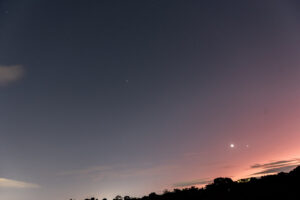 Right after sunset, people will see Jupiter and Mercury appear side by side on the westward horizon. They will be seen for a short time before disappearing below the horizon line. Just above Jupiter will be the third brightest natural object in the sky, Venus.
Following Venus will be Uranus. This planet may be difficult to locate — it will be just above Venus to the left. In unpolluted skies, Uranus will be very faint to see. One may need binoculars or a telescope to actually view this planet.
Mars will be the final planet in the planetary parade. The red planet will be fairly easy to locate as it will be close to the Waning Crescent moon.
Other Ways to View
Those who have newer smartphones can utilize apps like NightSky to help them find the planets. These kinds of apps use the camera from people’s phones to augment reality to show them exactly where each planet is in the planetary parade.
The planetary parade will be happening during the time period usually earmarked by amateur astronomers as the Messier Marathon. This is when 110 various deep sky objects originally cataloged by the French astronomer, Charles Messier, will come into view of Earth’s skies.
Head of NASA’s Meteoroid Environment Office at the Marshall Space Flight Center, Bill Cooke, stated, “Of course, the capper will be the moon, which will be halfway lit up just above Mars. So you’ll get five planets and the moon.” He said this when he spoke with “Good Morning America” about the best ways to view the planetary parade. Cooke also holds a Ph.D. in astronomy.
Next Planetary Parade
If anyone misses the chance to see this alignment come to its full effect on March 28 will have to wait until Sept. 8, 2040. Then the rare planetary parade will consist of Mercury, Jupiter, Venus, Saturn, and Mars.
All of the planets “will be visible within 10 degrees.” Adding that it will “be pretty darn impressive.” However, his favorite planet, Saturn, will not be part of this planetary parade.
I’m always partial to Saturn because of the rings, right? I mean, who can resist?
The upcoming planetary alignment is happening just in time to help kick off spring.
By Sheena Robertson
Sources:
ABC News: How to watch the 5-planet alignment: Jupiter, Mercury, Venus, Uranus and Mars
Space: 5 planets will align on March 27 and you won’t want to miss it. Here’s where to look.
KRLD NewsRadio 1080: 5 planets will align in a ‘planetary parade’ next week. Here’s how and when to see it.
Top and Featured Image Courtesy of Rob Pettengill’s Flickr Page – Creative Commons License
Inset Image Courtesy of cafuego‘s Flickr Page – Creative Commons License




