
















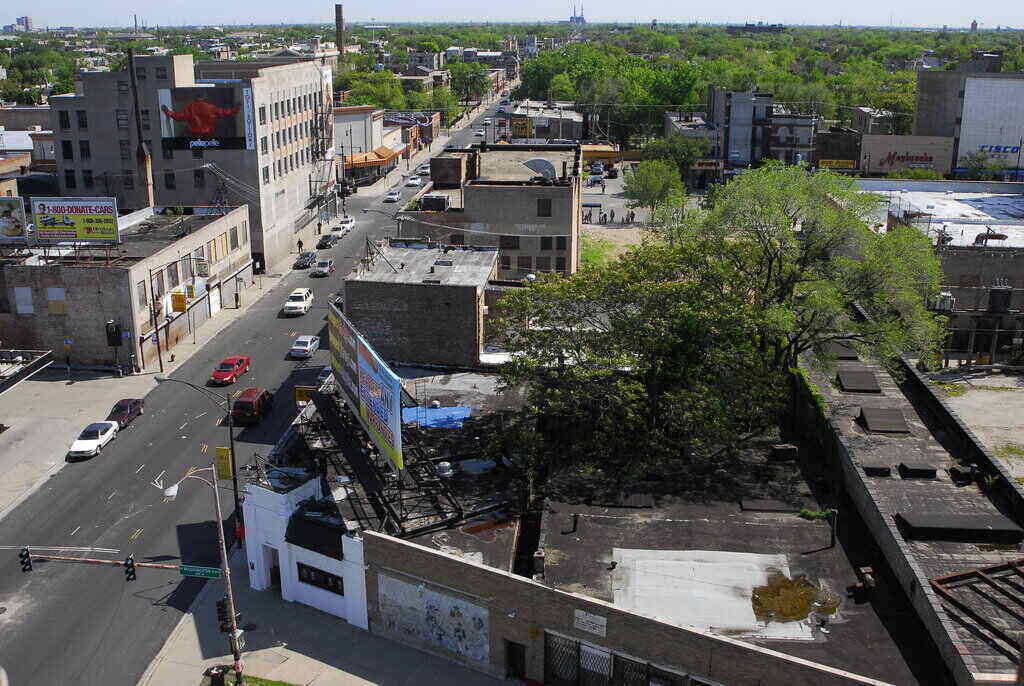
A new report has revealed that areas on the West and South sides are experiencing significant declines in their Black populations, according to WBEZ Chicago. As a result, these communities are seeing detrimental socioeconomic consequences. The effects are staggering compared to Black populations in other areas of the city.
Black residents have been steadily leaving the Chicago area since their peak population in 1980. As of 2020, Black residents have decreased by about 400,000 people reaching a near-record low.
The Chicago Urban League, an affiliate of the National Urban League, and WBEZ find that these declining numbers are correlated with decreasing jobs and businesses, more frequent demolitions, and higher crime rates.
Neighborhoods with the greatest loss of Black residents have seen a greater decline in active business licenses compared with other areas of the city. These same critical neighborhoods have experienced a decrease in jobs, whereas the rest of the city has seen an increase.
Further, “nearly two-thirds” of victims of gun violence in Chicago since 2010 reside in the same areas that have seen the sharpest decline in Black residents since 2000.
Impact in North Lawndale
Since 2000, North Lawndale has lost over 8000 Black residents. Economic disenfranchisement and crime have climbed in the wake of the loss.
Researchers from the University of Illinois’ Great Chicago Cities Institute found “$124 million leaks out of Lawndale each year, seriously impending community wealth building.” Over half of the jobs within North Lawndale are held by white people despite white residents being a minority in the neighborhood. Residents are also pushed to leave North Lawndale to purchase “basic necessities,” as it is not readily available within the neighborhood.
North Lawndale, along with other predominantly Black and Latine communities on Chicago’s West and South sides, face increased food insecurity. As of 2021, North Lawndale has 15 food stores, over half of which carry “fewer than five varieties of produce,” according to the Chicago Department of Public Health.
Persisting Complications
New businesses in the neighborhood are working to combat the disenfranchisement of Black workers and residents. 2022 saw the opening of North Lawndale Meat & Produce, the neighborhood’s only Black-owned grocery store. Other small businesses like Black-owned café Momentum Coffee have opened locations in North Lawndale.
However, extraneous factors may complicate the ability of Black residents to stay within North Lawndale and benefit from community investments.
In 2021, the Lawndale Christian Development Corporation launched an initiative to bring more affordable housing to North Lawndale. In its first phase, 250 homes are set to be built in vacant lots across the neighborhood. These developments are actively fighting against the effects of an inflated market. Construction costs and interest rates have skyrocketed as the Federal Reserve tries to contain inflation. Additionally, the city issued 10 demolitions within North Lawndale in the past 12 months.
North Lawndale also experiences increased crime compared to other Chicago neighborhoods, in trend with the decrease of Black residents. The Chicago Data Portal reported over 6,000 crimes in the past year.
Possible Solutions
The solution to steadily increasing Black depopulation in North Lawndale and similar neighborhoods on the West and South sides lies in greater investments into their housing, employment, and education, which is causing Black residents to move into other areas of the city and the suburbs.
Former mayor Lori Lightfoot attempted to tackle some of these issues with her “INVEST South/West” initiative. The program sought to bring $2.2 billion in public and private investments to areas on the South and West sides. Mayor Brandon Johnson will most likely discontinue the program.
Along with the aforementioned affordable housing initiatives and Black-owned businesses, organizations and community leaders within North Lawndale are seeking to educate and instill neighborhood pride among residents.
Written by Elena Wilson
Sources:
WBEZ: Chicago areas with steep Black population decline see more violence and job loss; by Alden Loury
Block Club Chicago: Lawndale Has Been Robbed Of Equitable Investment For Generations, New Study Finds; by Pascal Sabino
Chicago Sun-Times: Black-owned cafe opening West Side locations: ‘An investment in peace’; by Michael Loria
Chicago Department of Public Health: The Challenge to an Apple a Day: The Availability of Fresh Produce in Chicago Communities; by Daniel Block, Jessica Hooberman, Darrell Moore, Rich Noty, LaDonna Redmond, & Erica Salem
WGN Radio: High housing costs push inflation up ahead of Fed meeting; by Adam Barnes, The Hill
Chicago Cityscape: North Lawndale Place Report; by Chicago Cityscape
Chicago Data Portal: Crimes – Map; by Chicago Data Portal
City of Chicago: INVEST South/West; by City of Chicago
Block Club Chicago: Hundreds Of Affordable Homes Coming To North Lawndale After City Approves $5.3 Million In Funding; by Pascal Sabino, Justin Laurence
WTTW: North Lawndale; by Monique Wingard
Featured and Top Image Courtesy of Nitram242‘s Flickr Page – Creative Commons License
Inset Image Courtesy of Jacob G.’s Flickr Page – Creative Commons License




