















Terms to Know
- Sunspot: Sunspots are areas that appear dark on the surface of the Sun. They appear dark because they are more relaxed than other parts of the Sun’s surface. The temperature of a sunspot is still very hot though —around 6,500 degrees Fahrenheit!
- Solar flare: A solar flare is an intense burst of radiation from the Sun.
- Solar storm: This term is used to describe atmospheric effects on Earth that are caused by the Sun. These usually occur when the sun exerts a burst of energy in the form of solar flares and coronal mass ejections.
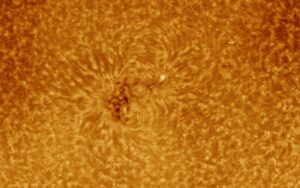
A gigantic sunspot was found on the surface of the sun and was ranked as an extreme X-class flare. X-class flares are considered the most dangerous type of a solar flare the sun could produce. When this solar storm slammed into our planet, it caused radio blackouts across the U.S., but experts say that this issue could have been a lot worse.
This dark patch was named AR3354. It surfaced from the sun on June 27 and took less than two days to grow 1.35 billion square miles. Just for imagery, this flare would be ten sizes bigger than our Earth. Space scientists who studied this rapid emergence were unnerved and were worried that it could create more solar storms, stated Spaceweather.com.
After the sunspot reached its final size, it produced a M-class flare on June 29th. The sunspot was generally still and unbothered until July 2nd. On this day, an X-class flare emerged and was aimed toward Earth.
(Note: solar flare classes from least to most dangerous are A, B, C, M, and X. Going up the latter class, each category is about ten times stronger than the last.)
The Results of the X-Class Flare
This X-class flare pierced through the Earth’s magnetic fields and the ionized gasses in its atmosphere with its powerful radiation. This action transformed the molecules into thick and dense plasma. Shortly after a blackout happened, this event spread all across the Western side of the U.S. and the Eastern Pacific Ocean, says the National Oceanic and Atmospheric Administration (NOAA).
This event lasted about 30 minutes. However, reporters state that this event could have ended terribly. It was said that this flare could have produced a Coronal mass ejection (CME)—this is a swift magnetized cloud of plasma. If a flare this size shot down a CME towards us, it would disturb the Earth’s magnetic field. This event is known as a geomagnetic storm. In the end, it would have resulted in a radio blackout even more significant than before, and it would affect up to half the entire planet.
Additionally, it would also damage the orbiting satellites around the earth and affect its power infrastructure. Thankfully, since a CME had not been launched, we did not suffer from these casualties. However, the size of A3345 has not decreased and remains capable of throwing out more M and X-class flares in the upcoming days. This could potentially launch CMEs down to earth.
The Next Solar Flare
As the sun reaches its maximum, a sunspot will grow larger and will become more frequent. They say that this is “the most active part of its solar cycle.” Consequently, the number and force of these solar flares also increase.
As of December 2018, the start of the solar flare began. Scientists hypothesized that it would reach its final form in 2025 and that the next solar maximum would come sooner than the last. Not only this, but they also stated that it would have a much stronger peak than what they intended. (The last solar flare indicated that the solar peak is approaching at a fast rate.)
A3354 is said to be the largest sunspot region as well as the second largest of this solar cycle, as reported by SpaceWeatherLive.com. Moving on the number of sunspots has increased at a much faster paste than expected. Over 28 months, the sun developed a plethora of dark spots on its surface. The NOAA predicted this change, but they had not expected such a large amount.
This year, the Earth has faced nine solar flares in total. The one mentioned earlier was that ninth. In January, there was a “surprise x-class” flare that burst from a concealed sunspot on the sun’s far side. This position shot a flare down and narrowly missed Earth. February also displayed another X-class flare. This one, however, exploded beside a plasma shockwave, also known as a “solar tsunami” which hit our planet. This flare also resulted in radio blackouts.
By: Khalyse Hemingway
Sources
NASA: sunspots and solar flares
Space Weather: What’s up in space
NOAA: CURRENT SPACE WEATHER CONDITIONS on NOAA Scales
Wonderopolis: What is a solar storm?
Inset image courtesy of Kevin Gill Flicker page -Creative Commons License
Featured image courtesy of Ars Electronica Flicker page -Creative Commons License




